|
|
Ibero-American
Journal of Psychology and Public Policy |
Research Article January 2026 | Volume 3 | Number 1 |

Virtual Reality: A viable strategy for public speaking anxiety in university students and graduates
(Realidad Virtual: Una estrategia viable para la ansiedad a hablar en público en estudiantes universitarios y egresados)
Gabriela P. Ayala-Almarza 1, Vanetza E. Quezada-Scholz 2,*, María Consuelo San Martín 3, Mario A. Laborda 4, Gonzalo Miguez 5, Matías F. Silva 6, Gressley A. Valdés 7, Carolina C. Salazar 8, Sarai A. Espinoza 9, Jorge E. Fuentealba-Valdés 10, Sebastián Ibacache-Ramírez 11, Luis Pardo-Garrido 12
1 Department of Psychology, Universidad de Chile, Chile;
gabriela.ayala@ug.uchile.cl 
2 Department of Psychology, Universidad de Chile, Chile;
qvanetza@u.uchile.cl
3 School of Psychology, Universidad de Los Andes, Chile;
mcsanmartin@uandes.cl
4 Department of Psychology, Universidad de Chile, Chile;
mariolaborda@u.uchile.cl
5 Department of Psychology, Universidad de Chile, Chile;
gonzalo_miguez@uchile.cl
6 Department of Psychology, Universidad de Chile, Chile;
matias.silva.n@ug.uchile.cl
7 Department of Psychology, Universidad de Chile, Chile;
gressley.valdes@ug.uchile.cl
8 Department of Psychology, Universidad de Chile, Chile;
carolina.salazar.s@ug.uchile.cl
9 Department of Psychology, Universidad de Chile, Chile;
sarai.espinoza@ug.uchile.cl
10 Research Center for Social Complexity, Universidad del
Desarrollo, Chile; j.fuentealbav@udd.cl
11 Department of Psychology, Universidad de Chile, Chile;
sebastianibacache@ug.uchile.cl
12 School of Psychology, Pontificia Universidad Católica de Chile,
Chile; lpardog9@estudiante.uc.cl
* Correspondence: qvanetza@u.uchile.cl
|
Reference: Ayala-Almarza, G. P., Quezada-Scholz, V. E., San Martín, M. C., Laborda, M. A., Miguez, G., Silva, M. F., Valdés, G. A., Salazar, C. C., Espinoza, S. A., Fuentealba-Valdés, J. E., Ibacache-Ramírez, S., & Pardo-Garrido, L. (2026). Virtual Reality: A viable strategy for public speaking anxiety in university students and graduates (Realidad Virtual: Una estrategia viable para la ansiedad a hablar en público en estudiantes universitarios y egresados). Ibero-American Journal of Psychology and Public Policy, 3(1), 107-142. https://doi.org/10.56754/2810-6598.2026.0044 Editor: Luis Quiroga Baquero,
Universidad Santo Tomás, Colombia Reception date: 15 May 2025 Acceptance date: 20 Jan 2026 Publication date: 28 Jan 2026 Language: English and Spanish Translation: Helen Lowry Publisher’s Note: IJP&PP remains neutral with regard to jurisdictional claims in published maps and institutional affiliations.
Copyright: © 2026 by the authors. This article is an open access article distributed under the terms and conditions of the Creative Commons Attribution (CC BY NC SA) license (https://creativecommons.org/licenses/by-nc-sa/4.0/). |
Abstract: Public speaking anxiety is a frequent manifestation of social anxiety among university students and recent graduates, with significant implications for well-being, academic performance, and professional development. Given the high prevalence of anxiety disorders in Chile, accessible and cost-effective interventions are needed. This research evaluated the feasibility and preliminary effects of a brief virtual reality exposure therapy protocol delivered in both face-to-face and remote modalities. Two non-randomized single-group pretest–posttest studies with repeated measures were conducted. Study 1 (n = 9), delivered in person over five sessions, showed a significant reduction in negative self-verbalizations and an increase in confidence for public speaking, along with changes consistent with the expected direction in other variables. Study 2 (n = 5), remote and using a flexible 6–8-session protocol, showed full adherence, a significant increase in positive self-verbalizations, a relevant decrease in negative ones, and a significant improvement in public speaking confidence. In addition, a clinically significant decrease was observed in the CORE-OM subscales of Problems/Symptoms and Functioning. Taken together, the results indicate that this intervention is feasible and potentially effective, with flexibility for implementation in either face-to-face or remote modalities. Its relevance for university settings establishes it as a promising tool within mental health promotion and preventive efforts, providing preliminary evidence to improve access to and the quality of psychological care in higher education. Keywords: social anxiety; fear of public speaking; cognitive behavioral therapy; exposure therapy; emerging technologies; student mental health. Resumen: La ansiedad al hablar en público es una manifestación frecuente de ansiedad social en estudiantes y egresados universitarios, con efectos en el bienestar, el rendimiento académico y la proyección profesional. Dada la alta prevalencia de los trastornos ansiosos en Chile, se requieren intervenciones accesibles y costo-efectivas. Esta investigación evaluó la viabilidad y los efectos preliminares de un protocolo breve de terapia de exposición mediante realidad virtual, aplicado en modalidad presencial y remota. Se realizaron dos estudios pretest–postest de un solo grupo, con medidas repetidas y sin asignación aleatoria. El Estudio 1 (n = 9), presencial y de cinco sesiones, mostró una reducción significativa de las autoverbalizaciones negativas y un aumento de la confianza para hablar en público, junto con cambios coherentes en la dirección esperada en otras variables. El Estudio 2 (n = 5), remoto y con un protocolo flexible de 6 a 8 sesiones, presentó adherencia total, un aumento significativo de autoverbalizaciones positivas, una disminución relevante de las negativas y una mejora significativa en la confianza para hablar en público. Además, se observó una disminución clínicamente significativa en las subescalas de Problemas/Síntomas y Funcionamiento del CORE-OM. En conjunto, los resultados indican que esta intervención es viable y potencialmente eficaz, con flexibilidad para ser implementada en modalidad presencial o remota. Su pertinencia para contextos universitarios la posiciona como una herramienta prometedora en estrategias de promoción y prevención en salud mental, aportando evidencia preliminar relevante para mejorar el acceso y la calidad de la atención psicológica en educación superior. Palabras clave: ansiedad social; miedo al hablar en público; terapia cognitivo conductual; terapia de exposición; tecnologías emergentes; salud mental estudiantil. Resumo: A ansiedade de falar em público é uma manifestação frequente da ansiedade social em estudantes e egressos universitários com efeitos sobre o bem-estar, o desempenho acadêmico e a projeção profissional. Dada a alta prevalência dos transtornos ansiosos no Chile, são necessárias intervenções acessíveis e custo-efetivas. Esta pesquisa avaliou a viabilidade e os efeitos preliminares de um protocolo breve de terapia de exposição por meio de realidade virtual, aplicado nas modalidades presencial e remota. Foram realizados dois estudos pré-teste–pós-teste de grupo único, com medidas repetidas e sem alocação aleatória. O Estudo 1 (n = 9), presencial e com cinco sessões, mostrou uma redução significativa das autoverbalizações negativas e um aumento da confiança para falar em público, juntamente com mudanças coerentes com a direção esperada em outras variáveis. O Estudo 2 (n = 5), remoto e com um protocolo flexível de 6 a 8 sessões, apresentou adesão total, um aumento significativo das autoverbalizações positivas, uma diminuição relevante das negativas e uma melhora significativa na confiança para falar em público. Além disso, observou-se uma diminuição clinicamente significativa nas subescalas de Problemas/Sintomas e Funcionamento do CORE-OM. Em conjunto, os resultados indicam que essa intervenção é viável e potencialmente eficaz, com flexibilidade para ser implementada de forma presencial ou remota. Sua pertinência para contextos universitários a posiciona como uma ferramenta promissora em estratégias de promoção e prevenção em saúde mental, oferecendo evidências preliminares relevantes para melhorar o acesso e a qualidade da atenção psicológica no ensino superior. Palavras-chave: ansiedade social; medo de falar em público; terapia cognitivo-comportamental; terapia de exposição; tecnologias emergentes; saúde mental dos estudantes.
|



1. Introduction
The World Health Organization's World Mental Health Report (2023) reveals a sustained increase in the mental health crisis, evidenced by a 25% rise in the global prevalence of anxiety and depression-related disorders. In Chile, the ACHS-UC Mental Health Thermometer reported that nearly one in four people (23.6%) experience anxiety symptoms (UC Center, 2024), underscoring the continued prevalence and significance of this type of psychological distress among the Chilean population.
Among the most common anxiety disorders (ADs), Social Anxiety Disorder (SAD) is the most prevalent. The Diagnostic and Statistical Manual of Mental Disorders (DSM-5-TR) defines it as intense fear or anxiety in one or more social situations where the individual is exposed to possible evaluation by others (American Psychiatric Association [APA], 2022). Public speaking anxiety, or performance anxiety, is a specific subtype of SAD, identified in individuals who experience significant distress when speaking or performing in public (APA, 2022).
However, interaction in society requires regular public performances, both in academic and professional settings. In the literature, fear or anxiety about public speaking is described as the body’s psychophysiological and behavioral response due to negative anticipatory thoughts regarding one's ability to face an audience. This difficulty can profoundly impact social relationships and undermine an individual's academic and/or professional performance, adversely affecting their well-being and reducing their job opportunities (Girondini et al., 2023).
The frequency and impact of anxiety disorders (ADs) necessitate improved access to effective and affordable interventions. One of the most effective interventions for ADs is Cognitive Behavioral Therapy (CBT; Chowdhury & Khandoker, 2023; Kaczkurkin & Foa, 2015; Kindred et al., 2022), understood as a comprehensive approach that integrates various techniques aimed at modifying distress-related thought, behavior, and learning patterns. One of the core components of CBT in the treatment of ADs is exposure therapy, a behavioral strategy based on the associative status of fear as a core process in these disorders. In this framework, the anxiety response is acquired through the association of an initially neutral stimulus (conditioned stimulus, CS) and a stimulus that inherently elicits fear (unconditioned stimulus, US), thereby providing the CS with the ability to trigger anticipatory fear.
Exposure therapy involves repeated confrontation with feared stimuli (objects, situations, interoceptive cues, or memories) in the absence of the expected aversive outcome. Procedurally, this is equivalent to fear extinction, where the conditioned stimulus (CS), previously associated with an aversive outcome (US) is presented repeatedly without being followed by the latter (Craske et al., 2014, 2022). Exposure seeks to promote the reactivation of memories linked to feared stimuli through corrective information, considering that experiencing feared situations is key to activating mental representations, challenging dysfunctional thoughts and facilitating new learning (Rodenbaugh et al., 2004).
In clinical terms, exposure therapy involves confronting the feared stimulus (CS) without the anticipated threat (US) occurring, thus facilitating new learning. It can be implemented in various formats, such as in vivo exposure, imagery, or the use of technologies like virtual reality (VR) (Hall et al., 2024). In recent years, VR has emerged as a promising tool for conducting this type of intervention. Virtual Reality Exposure Therapy (VRET) uses virtual environments to expose patients to stimuli that trigger anxiety and/or threat expectations. Typically, these stimuli are presented using a head-mounted display (HMD), which employs motion tracking and binocular graphics with a wide field of view to create an immersive experience (Chard & van Zalk, 2022).
VR offers several advantages: (a) it allows controlled and gradual exposure through immersive environments, which can facilitate engagement and adherence to treatment; (b) it enables real-time observation of the patient's response to different stimuli; and (c) it offers a potentially more accessible format, as it can be implemented remotely, optimizing the cost-benefit ratio (Pedram & Piatkowski, 2025).
In this vein, available evidence suggests that remote CBT can be effective in the treatment of SAD, particularly when it incorporates components such as psychoeducation and, critically, exposure therapy (Gadelha et al., 2021; Tan et al., 2025). In this regard, VRET has been studied as a specific intervention that has shown favorable results in symptom reduction and in the design of treatments adapted to different clinical needs (Chard & van Zalk, 2022; Chesham et al., 2018; Emmelkamp et al., 2020). This is consistent with evidence indicating that online interventions can expand access beyond face-to-face healthcare services, including for people with reduced mobility due to medical or geographical constraints, without necessarily jeopardizing the quality of service provided (Löchner et al., 2025). Similarly, the implementation of treatment programs through the Internet and mobile devices can optimize professional time and resources by making the management of treatments more efficient and reducing the associated costs. In addition, these digital interventions can help reduce or avoid interruptions in care (Whaibeh et al., 2020).
VR intervention protocols for fear of public speaking typically last between 12 and 16 sessions and include components such as psychoeducation, cognitive restructuring, and graded exposure. Recent evidence reports that these programs produce significant improvements in anxiety, maladaptive beliefs, and communication performance, with sustained effects in subsequent follow-ups (Lindner et al., 2019; Zeka et al., 2024; Zeng et al., 2025). At the same time, contemporary studies have demonstrated the effectiveness of shorter protocols, between 4 and 8 sessions, maintaining good levels of adherence and clinically relevant reductions in performance anxiety (Lindner et al., 2021).
In Chile and Latin America, the use of VRET is scarcely applied and researched (Santoyo et al., 2021). The technological gap compared to developed countries is likely one of the main reasons. Therefore, it is important to move towards the development of VR protocols that demonstrate effectiveness in addressing mental health problems and contribute to improving access to cost-effective interventions throughout the countries of the region.
Furthermore, there has recently been a rise in the rates of mental health decline among university students. Therefore, the development and assessment of cost-effective protocols for addressing mental health issues is crucial to promoting a significant improvement in university students’ functioning and quality of life (González & Quezada, 2016), which would positively impact human capital development, social mobility, and equity in Chile. This is consistent with the guidelines of the National Mental Health Plan 2017-2025 (Ministerio de Salud [MINSAL], 2017) and with the National Health Strategy for Achieving the Health Objectives of the 2021-2030 Decade of the Government of Chile (MINSAL, 2022). The impact objectives include improving the mental health of the Chilean population by focusing on promotion and prevention, as well as expanding and enhancing programs and/or initiatives that support mental health across the life course.
2. Objective
This research sought to evaluate the feasibility of a brief VRET to reduce public speaking anxiety in university students and graduates. To this end, two studies were conducted, implementing the intervention in two formats: one in-person and the other remote.
3. Study 1
3.1 Method
3.1.1 Design
A single-group, repeated-measures, non-randomized pretest-posttest design was used.
3.1.2 Participants
The sample consisted of nine graduates from the Law program at the University of Chile, three of whom were female ( M age = 43.1 years, SD = 11.32), who reported difficulties or anxiety associated with public speaking. Only participants whose scores on the psychological dimensions assessed by the Symptom Checklist-90-R (SCL-90-R; Derogatis, 1975) did not exceed the reference values for the cohort were included. Participants with a medical or psychiatric history that could interfere with the safety or implementation of the intervention were excluded, including: (a) vertigo, (b) epilepsy, (c) alcohol or other substance use, (d) depression, and (e) psychosis. These conditions were verified using a preventive medical questionnaire (Quezada et al., 2022).
The processes were carried out by therapists who were licensed psychologists or graduates currently enrolled in or had completed the Postgraduate Diploma in Cognitive Behavioral Therapy at the University of Chile. These therapists received training on the treatment protocol and safety protocols for risks associated with the use of VR (such as dizziness or temporary blurred vision). They were supervised three times during the treatment to monitor the progress of the assigned participants, identify barriers and facilitators, and ensure the successful implementation of the intervention.
3.1.3 Instruments
3.1.3.1 Virtual Reality Instruments
The VR device used was Oculus Go, and the software employed for presenting stimuli was Virtual Speech, a VR training platform designed for practicing public speaking and presentations to virtual audiences. This software simulates different presentation scenarios with variations in context and audience size, fostering an immersive experience. The program's interface and content are in English, so support was needed during the sessions to ensure participants understood the instructions and stimuli presented.
3.1.3.2 State-Trait Anxiety Inventory (STAI; Ibacache-Ramírez et al., 2025)
The version validated for Chile by Ibacache-Ramírez et al. (2025) was used. This questionnaire consists of 40 items with two subscales that measure state anxiety (STAI-E) and trait anxiety (STAI-R). State anxiety is a transient condition that can vary in intensity over time, whereas trait anxiety indicates a more stable, anxious predisposition. Each subscale contains 20 items. Higher scores indicate greater anxiety (state or trait). The instrument includes items worded positively and negatively and therefore uses reverse-scored items for calculating total scores. The Chilean version has good internal consistency for both subscales (.92 for STAI-E and .87 for STAI-R).
3.1.3.3 Liebowitz Social Anxiety Scale (LSAS; Liebowitz, 1987)
The study employed the 24‑item Spanish version by Bobes et al. (1999). It is divided into two subscales: one related to performance anxiety and the other to social situations that are frequently problematic for people with social anxiety. It assesses the degree of fear or anxiety experienced in these situations and the degree of avoidance in each subscale. It has excellent internal consistency (coefficients ranging from .72 to .88) based on the total number of social anxiety and social avoidance items. High test-retest reliability has also been reported (Baker et al., 2002). The scale assesses two dimensions for each situation: fear/anxiety and avoidance, thus constituting two main scores (total anxiety and total avoidance). It also obtains scores associated with two domains: performance anxiety and social anxiety. In each case, a higher score reflects greater social anxiety and/or greater avoidance. The items are presented in a descriptive formulation of social situations and do not include reversed-score items.
3.1.3.4 Self-Verbalization Scale for Public Speaking (SSPS; Hofmann & DiBartolo, 2000)
The Mexican version (de la Rubia et al., 2012), consisting of 10 items divided into two 5-item subscales, the positive self-statements subscale (SSPS-P) and the negative self-statements subscale (SSPS-N), was used. Item 8 of this version includes the phrase “la voy a regar,” commonly used in Mexico to mean “I’m going to mess up”, so it was adapted to “la voy a embarrar,” which is more widely used in Chile. The adaptation and validation of the scale in the Mexican population showed acceptable internal consistency (α = 0.70) and good test-retest reliability at three months for both subscales (positive self-statements, r = 0.78; negative self-statements, r = 0.80; Hofmann & DiBartolo, 2000). The SSPS-P includes statements phrased positively, and a higher score indicates a greater presence of positive self-statements associated with public speaking performance. The SSPS-N includes negatively worded statements, and a higher score indicates a greater presence of negative self-statements. The subscales are analyzed separately and do not require item reversal for interpretation.
3.1.3.5 Personal Report of Confidence as a Speaker (PRCS-12; Hook et al., 2008)
The study employed the Spanish version validated in a university population (Martínez‑Pecino & Durán, 2013). It consists of 12 items. This instrument measures the degree of confidence with which a presentation is given and the degree of fear of public speaking; lower scores on the scale indicate greater confidence in public speaking. This instrument demonstrates excellent internal consistency (α = .899; Martinez-Pecino & Durán, 2013) and good test-retest reliability (Méndez et al., 2004). The scale comprises items worded positively and negatively and therefore includes reversed-score items for calculating the total score. The instrument provides an overall score, where higher scores reflect greater fear/insecurity in public speaking, and lower scores reflect greater confidence.
3.1.3.6 Adapted Change Interview (Elliot & Rodgers, 2008)
This semi-structured interview was included at the end of the intervention to explore participants' subjective experiences and their perception of the change they attributed to it. It lasted approximately 30 to 45 minutes and consisted of ten thematic sections, encompassing more than 20 open-ended and closed-ended questions. The topics covered included general experiences during the intervention, perception of personal changes, causal attributions for these changes, personal or contextual resources and limitations, useful and problematic aspects of the intervention, and suggestions for improvement. This information complemented the quantitative data, providing a deeper and more context-sensitive understanding of the intervention's subjective impact.
3.1.4 Procedure and ethical safeguards
A brief virtual reality treatment protocol for fear of public speaking was designed, adapted from the protocol by Lindner et al. (2019). The intervention consisted of five weekly sessions, each lasting approximately 50 minutes to 1 hour. The first session was conducted in a group setting, and subsequent sessions were held individually (see Table 1). In the exposure sessions, participants used a VR headset (Oculus Go) and the Virtual Speech software to view stimuli in public speaking scenarios. Since the software was in English, the therapist provided support for understanding the instructions and verbal cues as needed. The STAI, LSAS, SPPS, and PRCS-12 questionnaires were administered at the end of the first and last treatment sessions. The exposure sessions progressed gradually according to an individualized hierarchy, progressively increasing the difficulty of the scenario and the perceived demand on the participant.
All participants signed an informed consent form that ensured the confidentiality of their data and their right to withdraw at any time without consequence. The study was approved by the Ethics Committee of the Faculty of Social Sciences at the University of Chile (32-30-2017), guaranteeing compliance with relevant ethical standards. There was no cost associated with participation.
Table 1
Virtual Reality Exposure Protocol (VREP)
|
Session |
Main component |
Goals |
Activity |
|
1 |
Psychoeducation. |
Conduct a psychoeducational workshop. |
Workshop. |
|
2 |
Exposure/Training (VR adaptation). |
Address avoidance through VR exposure. |
Create hierarchies and present to a small audience. |
|
3 |
Exposure/Training (VR adaptation). |
Address avoidance through VR exposure. Analyze irrational beliefs. |
Improvise in the interview audience and work team / slow diaphragmatic breathing, and distractions. |
|
4 |
Exposure. |
Expose the participant to an audience similar to that of their degree exam. |
Present ID card in an auditorium (audio and audio feedback). |
|
5 |
Evaluation and closure. |
Close the intervention and relapse prevention. |
Feedback and change interview. |
Note. The table shows how the protocol was developed chronologically and the sessions were planned throughout Study 1.
3.1.5 Analysis Strategy
The assumption of normality of the differences between time points was assessed using the Shapiro-Wilk test (with W statistic values from 0.866 to 0.976, all with non-significant probability values), suggesting normality. However, given that the QQ plots indicate some deviations, the traditional paired t-test was performed, as well as a t-test using non-parametric bootstrapping with pooled resampling (Dwivedi et al., 2017).
Although the results are identical, the estimates obtained via bootstrapping are reported, as this approach is advantageous in studies with small sample sizes: it does not require specific sampling distributions and provides reliable results under varied conditions. It has also been shown to outperform the standard paired t‑test when pre–post correlations are high (Dwivedi et al., 2017), which applies to some of our measures.
Despite most researchers recommending at least 2,000 replications (Wright et al., 2011), 10,000 replications were performed to obtain more stable estimates given the small sample size. Cohen's d is reported as the effect size measure, calculated as t/√(n). A p-value of 0.05 was used. Analyses were performed using the npboottprm package in RStudio (Ncube, 2024).
To obtain a more complete view of the data, measures of individual change were estimated to determine whether the observed change exceeds what would be expected due to measurement error. While the Reliable Change Index is the most widely used measure in psychotherapy research (Keller & Alexandrowicz, 2024), its calculation requires test-retest reliability data (Ferrer & Pardo, 2014), which are not available for the Chilean population. The common practice of using internal consistency instead (Keller & Alexandrowicz, 2024) tends to increase the rate of false positives (Ferrer & Pardo, 2014), so the less frequently used Standardized Individual Difference (SID) was calculated. The SID is calculated as the difference between each individual's pre- and post-treatment scores, divided by the standard deviation of that difference. In pre-post designs, the cutoff point for establishing reliable change beyond measurement error is 1.645 (Estrada et al., 2019). Positive values imply a reduction from pre- to posttest in variables with direct scores, where a higher score on the scale indicates a greater presence of the construct. A content analysis was used to systematically process the interview data to identify and differentiate topics and categories (Echeverría, 2005).
3.2 Results
3.2.1 Change at the group level
While no statistically significant differences were observed, the changes were in the expected direction for social anxiety (LSAS), positive self-statements (SSPS-P), and confidence in public speaking (PRCS, where a decrease in score reflects greater confidence). Significant differences were found for negative self-statements (SSPS-N) (p = .05). Effect sizes ranged from moderate (d = .30) to large (d = .75), with a particularly marked reduction in negative self-statements (see Table 2).
Table 2
Comparison of the beginning and end of the intervention
|
Variable |
t |
P |
Mean(SD) pre |
Mean(SD) post |
Pre-post difference |
Cohen's d |
|
STAI-E |
-1.22 |
0.25 |
16.44(1.74) |
17.44(2.19) |
-1.00 [-1.78, 1.78] |
-0.41 [-0.77, 0.76] |
|
STAI-R |
0.29 |
0.78 |
25.11(2.03) |
24.78(2.49) |
0.33 [-2.00, 2.00] |
0.10 [-0.75, 0.77] |
|
LSAS |
1.27 |
0.25 |
46.44(23.26) |
37.56(9.42) |
8.89 [-16.22, 15.89] |
0.42 [-0.78, 0.76] |
|
SSPS-P |
-0.89 |
0.40 |
16.78(4.47) |
17.89(3.02) |
-1.11 [-3.33, 3.33] |
-0.30 [-0.77, 0.77] |
|
SSPS-N |
2.24 |
0.05 |
12.33(3.08) |
10.67(3.87) |
1.67 [-3.11, 3.11] |
0.75 [-0.76, 0.75] |
|
PRCS |
1.40 |
0.20 |
38.78(9.13) |
36.00(9.89) |
2.78 [-8.33, 8.33] |
0.47 [-0.77, 0.78] |
Note. SD = standard deviation; STAI-E = state anxiety; STAI-R = trait anxiety; LSAS = social anxiety; SSPS-P = positive self-statements; SSPS-N = negative self-statements; PRCS = public speaking confidence (lower score = more confidence). Negative pre-post differences and effect sizes imply an increase in the variable after the intervention. Confidence intervals were calculated at the 95% level.
3.2.2 Change at the individual level
Reliable changes were observed in 5 of 9 participants (see Table 3), with reductions in trait anxiety (n = 1), social anxiety (n = 1), and negative self-statements (n = 1), as shown in Table 3, with positive SID exceeding the cutoff score of 1.645. Since the PRCS score is inverted, the reliable reduction observed in one participant can be interpreted as an increase in confidence in public speaking. An increase in positive self-statements (n = 1) and state anxiety (n = 1; SID = -2.45) was also found.
Table 3
Study 1 SID
|
Id |
STAI-E |
STAI-R |
LSAS |
SSPS-P |
SSPS-N |
PRCS |
|
S1 (F) |
-0.41 |
-1.44 |
-0.71 |
0 |
2.24* |
0 |
|
S2 (M) |
0.82 |
-0.29 |
-1.47 |
1.33 |
1.34 |
0.51 |
|
S3 (F) |
0.82 |
0 |
-0.05 |
-0.53 |
0.45 |
-1.18 |
|
S4 (M) |
-2.45 |
-0.29 |
0.95 |
-0.27 |
0.89 |
1.52 |
|
S5 (M) |
0 |
-0.29 |
1.14 |
-0.80 |
0.89 |
1.85* |
|
S6 (M) |
-0.41 |
0 |
0.76 |
-1.06 |
-1.34 |
0.84 |
|
S7 (F) |
-0.41 |
0.29 |
0.57 |
-1.86* |
0.89 |
1.18 |
|
S8 (M) |
-1.22 |
2.31* |
0.86 |
-0.53 |
1.34 |
0.17 |
|
S9 (M) |
-0.41 |
0.58 |
1.76* |
1.06 |
0 |
-0.67 |
Note. F = Female, M = Male; STAI-E: State anxiety (higher score = greater anxiety); STAI-R: Trait anxiety (higher score = greater anxiety); LSAS: Social anxiety (higher score = greater anxiety); SSPS-P: Positive self-statements (higher score = more positive); SSPS-N: Negative self-statements (higher score = more negative); PRCS: Confidence in public speaking (lower score = more confidence); * = significant change in the desired direction.
Regarding the interview, the content analysis distinguishes two main categories: (1) Indicators of change, referring to cognitive and behavioral changes perceived by the participants as a result of the intervention. Cognitive changes are reflected in the identification and questioning of maladaptive thoughts and/or their replacement with more appropriate ones, while behavioral changes refer to modifications in public speaking behavior; and (2) Intervention variables, divided into facilitating and hindering elements. Among the facilitating elements, VR stands out as a novel tool. Meanwhile, the hindering elements are the brevity of the intervention and the language barrier resulting from the Virtual Speech program.
3.3 Conclusion of study 1
Overall, the results show a heterogeneous pattern of change at both the group and individual levels, with particularly notable improvements in negative self-statements, where significant differences and large effect sizes were observed. Although most variables did not reach statistical significance, the changes were in the expected direction and were complemented by reliable evidence of change in a proportion of participants. Qualitative analyses support these findings, indicating the presence of perceived cognitive and behavioral transformations, as well as identifying factors that facilitated and hindered the intervention. Taken together, these results suggest that the intervention has the potential to generate clinically relevant changes, particularly in cognitive and confidence variables associated with performance. However, further research with more robust designs is needed to strengthen the inferential evidence and its generalizability. Furthermore, the findings should be interpreted with caution, considering the variability observed at the individual level among participants. In particular, in measures such as the State Anxiety Inventory-Induced (STAI-E), it is expected that some scores will not decrease and may even increase temporarily, given that exposure does not necessarily aim to reduce immediate anxious arousal, but rather to facilitate confrontation with the feared stimulus and the disconfirmation of threat expectations through corrective learning. In this sense, the changes observed in self-statements and confidence in public speaking are consistent with this objective. Among the main limitations of the study are the small number of sessions and the use of English-language software, whose verbalizations had to be simultaneously translated by the therapist, which likely reduced the level of immersion during exposure.
4. Study 2
4.1 Method
4.1.1 Design
The same design used in the first study was employed. Regarding the protocol, some changes were made based on the experiences reported by the participants and therapists in the first study. Due to the socio-health crisis experienced in Chile and the world (the "social uprising” in Chile and the COVID-19 pandemic), the intervention was redesigned. Hence, the protocol was adapted to be carried out remotely.
4.1.2 Participants
The sample consisted of five female university students (mean age = 21 years, SD = 1.26). Four were in their second to fifth year of Law at the University of Chile, and one was studying Psychology at the same institution.
The inclusion criteria were: (a) reporting anxiety or difficulty speaking in public, (b) not being in the process of obtaining a degree, (c) not receiving concurrent psychological treatment, (d) having suitable electronic devices for video calls and VR use, and (e) completing all stages of the intervention. Individuals with vertigo, epilepsy, alcohol or drug use, depression, or psychosis were excluded. These criteria were assessed using the Participant Form (Quezada et al., 2022) and the CORE-OM risk scale in Spanish (Feixas et al., 2012). The instrument has a reliable clinical significance/change index measurement for each dimension assessed.
The therapists met the same conditions described in Study 1.
4.1.3 Instruments
The same scales as the first study were used, and two were added: Clinical Outcomes in Routine Evaluation-Outcome Measure (CORE-OM) Questionnaire in its Spanish version (Feixas et al., 2012) and the Subjective Units of Anxiety Scale (SUDS; Wolpe, 1969) during the exposure sessions.
4.1.3.1 Virtual Reality Instruments
The public speaking scenarios from the Spanish VR platform Amelia Virtual Care were used, as they allowed for remote intervention and overcame language barriers, being available in Spanish. The devices used were cardboard VR headsets delivered to the participants' homes and their own cell phones. The cell phones had to meet the following technical requirements: (a) be mid-range/high-end, (b) have a gyroscope, (c) an accelerometer, (d) a stable connection, (e) a screen between 5.5 and 6.5 inches, and (f) be capable of downloading applications and content.
4.1.3.2 Subjective Units of Anxiety Scale (SUDS; Wolpe, 1969)
This scale, created by Wolpe (1969), was implemented using VR glasses, as it is integrated into the software used. This one-item self-report instrument subjectively records anxiety experienced. It is scored from 0 (No anxiety) to 10 (Extreme anxiety). It was implemented with repeated intra-session measurements to assess the variation in anxiety according to different audiences and the complexity of the sessions as treatment progressed.
4.1.3.3 Clinical Outcomes in Routine Evaluation-Outcome Measure (CORE-OM)
The Spanish version of the questionnaire by Feixas et al. (2012) was used. It is a 34-item self-report questionnaire designed to assess psychological distress and monitor therapeutic progress. It evaluates four domains: Subjective Well-being (W), Problems/Symptoms (P), General Functioning (F), and Risk (R). Higher scores indicate greater distress. It has adequate validity, reliability, and sensitivity to change (Trujillo et al., 2016) and an internal consistency between 0.7 and 0.9. The total score was calculated by taking the mean of the W, P, and F item scores, excluding Risk (R), and dividing the sum by the number of items answered (usually 28). To facilitate clinical interpretation, this mean can be multiplied by 10 (“ clinical score”; Barkham et al., 2006, as cited in Feixas et al., 2012). To assess pre-post change, a Reliable Change Index ≥0.5 in the mean of items (approx. 0.48 ) or ≥5 points in the clinical score was considered.
4.1.4 Procedure and ethical safeguards
The Virtual Reality Exposure Protocol (VREP) used in Study 1 was modified. The changes included: (1) the integration of a cognitive module separate from the exposure module, based on the Cognitive Flexibility module of the Unified Protocol for the Transdiagnostic Treatment of Emotional Disorders by Barlow et al. (2019), as well as an initial session practicing slow diaphragmatic breathing to be used throughout the treatment; (2) a greater number of sessions, allowing for the addition of a cognitive flexibility or exposure session depending on the participant's needs; and (3) a switch to the Amelia Virtual Care platform for virtual exposure, incorporating its clinical recommendations for conducting exposure, such as constructing an anxiety hierarchy to establish the stimulus configuration (see Table 4). Thus, the VREP consisted of 6 to 8 sessions, each lasting 50 minutes to 1 hour, conducted twice a week.
Table 4
Adapted Virtual Reality Exposure Protocol (VREP)
|
Number of sessions |
Module |
Aim |
Activity |
|
1 |
Psychoeducation. |
Provide psychoeducation about public speaking anxiety, symptoms, associative model of fear, CBT, and techniques to cope with public speaking anxiety. |
Group workshop. |
|
1 or 2 |
Cognitive Flexibility. |
Through an individual session, give participants the ability to address situations that provoke emotions and respond to them in a more useful and adaptive way. |
Cognitive module based on module No. 4 of the “unified protocol for the transdiagnostic treatment of emotional disorders” (Barlow et al. 2019). |
|
3 or 4 |
Exposure. |
Address avoidance through VR exposure. |
Establish hierarchies. Present to a small, informal audience. |
|
|
Exposure. |
Address avoidance through VR exposure. Analyze irrational beliefs. |
Improvise on various topics. Presentation with video feedback. |
|
|
Exposure. |
Expose the participant to an audience similar to an evaluation/ degree exam. |
Present academic record or evaluation in the auditorium (video feedback). |
|
1 |
Evaluation or closure. |
Close intervention and relapse prevention. |
Feedback and posttests. |
Note. The table shows how the protocol was developed chronologically, and the sessions were planned throughout Study 2.
The protocol consists of three modules: (1) Group Psychoeducational, (2) Cognitive, and (3) Exposure. The latter two were implemented individually. In the exposure module, participants used cardboard virtual reality headsets with their mobile phones to view immersive public speaking scenarios on the Amelia Virtual Care platform, gradually exposing the subject to increasingly complex virtual audiences. The exposure was guided by the therapist, who indicated the beginning and end of each scenario, monitored the emotional response, and supported the application of strategies learned during the intervention.
The STAI, LSAS, SPSS, PRCS-12, and CORE-OM questionnaires were administered before the first psychoeducation session and at the end of the final treatment session. The PRCS-12 was administered midway through the intervention (after the first exposure session). Subjective Units of Distress Scales (SUDS) were used repeatedly during exposure to determine when it was time to change the setting. Only when the patient's anxiety had stabilized and decreased did the intervention proceed as planned. Procedurally, the setting was changed only when SUDS scores showed a sustained reduction to promote habituation and/or corrective learning before increasing the difficulty. The average anxiety level observed in the study participants, as measured by SUDS, ranged from 4.74 in the first session, 5.04 in the second, 4.1 in the third, and 4.35 in the fourth exposure session.
This research was approved by the Research Ethics Committee of the Faculty of Social Sciences at the University of Chile (19 June 2021). Participants signed an informed consent form, and there was no financial compensation for their participation in the intervention.
4.1.5 Analysis Strategy
The same analytical strategy used in Study 1 was applied. Given that some differences between time points were small, certain iterations of the bootstrap procedure did not converge; these were excluded following the recommendations of Dwivedi et al. (2017). The rest of the analysis was performed identically to the previous study.
4.2 Results
4.2.1 Change at the group level
No significant differences were observed in state anxiety (STAI-E), trait anxiety (STAI-R), or social anxiety (LSAS), although the changes were in the expected direction. In contrast, positive self-statements (SSPS-P) showed a significant increase (p < .001) with a very large effect size. Negative self-statements (SSPS-N) showed a marginally significant reduction (p = .06) with a moderate effect size. Regarding public speaking confidence (PRCS), there were no significant changes between baseline and mid-term; however, a significant improvement was observed between mid-term and post-intervention (p = .01), with a large effect size (see Table 5).
Table 5
Average scores for pre- and post-treatment conditions
|
Variable |
t |
p |
Mean(SD) pre |
Mean(SD) post |
Difference of means |
Cohen's d |
|
STAI-E |
-1.58 |
0.19 |
14.60(1.82) |
18.00(3.94) |
3.40 [-4.00, 4.00] |
0.70 [-1.18, 1.44] |
|
STAI-R |
-1.17 |
0.31 |
27.60(2.88) |
29.60(2.61) |
2.00 [-3.20, 3.20] |
0.53 [-1.22, 1.26] |
|
LSAS |
0.52 |
0.64 |
69.40(27.87) |
65.40(26.78) |
-4.00 [-29.80, 30.20] |
-0.23 [-1.10, 1.10] |
|
SSPS-P |
-7.01 |
0.00* |
11.60(2.88) |
18.40(1.14) |
-6.80 [-4.80, 4.80] |
3.14 [-1.21, 1.20] |
|
SSPS-N |
2.53 |
0.06 |
21.20(1.92) |
18.60(1.52) |
-2.60 [-2.60, 2.40] |
-1.13 [-1.18, 1.24] |
|
PRCS start-end |
2.42 |
0.07 |
59.80(10.18) |
50.20(11.99) |
-9.60 [-13.80, 13.60] |
-1.08 [-1.13, 1.19] |
|
PRCS beginning-mid |
-1.18 |
0.31 |
59.80(10.18) |
62.80(7.12) |
3.00 [-9.80, 9.80] |
0.53 [-1.20, 1.20] |
|
PRCS mid-to-final |
3.97 |
0.01* |
62.80(7.12) |
50.20(11.99) |
-12.60 [-13.40, 13.40] |
-1.78 [-1.21, 1.25] |
Note. SD = standard deviation; STAI-E = state anxiety; STAI-R = trait anxiety; LSAS = social anxiety; SSPS-P = positive self-statements; SSPS-N = negative self-statements; PRCS = confidence in public speaking (lower score = more confidence), * = p < .05. Negative pre-post differences and effect sizes imply an increase in the variable after the intervention. Confidence intervals were calculated at 95%.
4.2.2 Change at the individual level
Increases were observed in state anxiety (n = 1) and trait anxiety (n = 1). Positive self-statements increased in all participants, while PRCS scores decreased from the beginning to the end of treatment (n = 2) and from the middle of the intervention to the end (n = 4), implying participants’ greater confidence in public speaking (see Table 6).
4.2.3 Change in the CORE-OM
Table 7 shows the changes between the start and end of treatment in the three CORE-OM subscales: General Well-being (W), Problems/Symptoms (P), and General Functioning (F). Although scores decreased across all dimensions, clinically significant change was evident only in Problems and Symptoms and in General Functioning, with both showing a Reliable Change Index (RCI) greater than 5 points (12 and 6.8, respectively).
Table 6
Study 2 SID
|
Id |
STAI-E pre-post |
STAI-R pre-post |
LSAS pre-post |
SSPS-P pre-post |
SSPS-N pre-post |
PRCS pre-post |
PRCS mid-start |
PRCS middle to end |
|
S01 |
0.83 |
-1.84 |
-1.11 |
-4.15* |
1.74* |
-0.23 |
-0.53 |
0.14 |
|
S02 |
-0.62 |
0.79 |
0.23 |
-2.31* |
2.17* |
1.80* |
-0.70 |
2.82* |
|
S03 |
-0.62 |
-0.53 |
-0.35 |
-1.85* |
-0.43 |
1.13 |
-0.35 |
1.69* |
|
S04 |
-1.86 |
-1.05 |
1.17 |
-3.69* |
0.87 |
2.25* |
0.88 |
2.11* |
|
S05 |
-1.24 |
0.00 |
1.23 |
-3.69* |
1.30 |
0.45 |
-1.93 |
2.11* |
Note. STAI-E: state anxiety (higher score = greater anxiety); STAI-R: trait anxiety (higher score = greater anxiety); LSAS: social anxiety (higher score = greater anxiety); SSPS-P: positive self-statements (higher score = more positive); SSPS-N: negative self-statements (higher score = more negative); PRCS: confidence in public speaking (higher score = more confidence); * = significant change.
Table 7
Average pre- and post-treatment scores on the CORE-OM dimensions
|
CORE-OM Dimension |
Pre-treatment |
Post-treatment |
ICC |
|
W |
7.8 |
3.8 |
4 |
|
P |
21.2 |
9.2 |
12 |
|
F |
16.8 |
10 |
6.8 |
Note. CORE-OM: Clinical Outcomes in Routine Evaluation-Outcome Measure; W: General Well-being ; P: Problems/Symptoms; F: General Functioning; ICC: Clinically Reliable Change Index, if equal to or greater than 5, it is interpreted as a clinically significant change.
Figure 1 shows the scores obtained on the total scale before and after treatment, with a difference of 8.02 points between measurements. It can be concluded that there was a clinically significant change, as assessed by the CORE-OM, from the beginning of the intervention to the end.
Figure 1
Total pre-test and post-test CORE-OM score
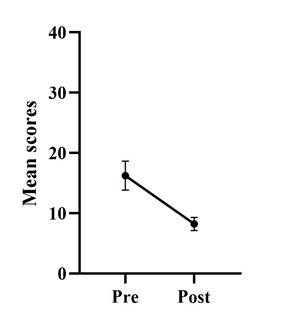
Note: The mean of the total scores obtained is plotted against the pre- and post-treatment data, with standard error bars shown for each phase. A decrease in the mean score is observed in the post-treatment phase.
4.3 Conclusion of study 2
Overall, the results of Study 2 show consistent changes in the expected direction at both the symptomatic and cognitive levels. Although not all variables reached statistical significance, relevant improvements were observed in positive self-statements and a marked reduction in negative self-statements, in addition to sustained increases in confidence in public speaking. Clinically, the CORE-OM scores showed a significant change in the Problems/Symptoms and Functioning subscales, with reliable change indices above the established threshold, suggesting perceived improvements in core areas of distress and daily functioning. Overall, these findings indicate that the intervention generated clinically and cognitively meaningful gains, although replication with larger samples is required to strengthen the robustness of the results.
5. General discussion
The aim of this research was to assess the feasibility of a brief intervention based on exposure therapy using VR to reduce the fear of public speaking, implemented in face-to-face (Study 1) and remote (Study 2) formats in university students and graduates who reported anxiety during evaluated presentations.
The results provide preliminary evidence that a brief VREP is implementable in both formats and is associated with a pattern of cognitive and functional changes, with consistent improvements in self-statements and confidence in public speaking, even though most of the global symptomatic variables did not reach statistical significance.
Exposure is a central component of CBT for anxiety disorders because it promotes new learning in the absence of the feared consequence, facilitating the modification of threat expectations and the updating of fear-associated memories (Craske et al., 2014, 2022). This process requires activating feared representations and sustaining the confrontation with corrective information, which also facilitates the questioning of maladaptive cognitions during or after the experience (Rodenbaugh et al., 2004). In this sense, the findings of both studies, particularly the reduction in negative self-statements (SSPS-N) and the increase in confidence in public speaking (PRCS), are consistent with the expected mechanisms of exposure: a progressive decrease in catastrophic interpretations and negative self-evaluations regarding social performance, along with a greater perception of self-efficacy in exposure situations.
These results also align with evidence that remote CBT has shown efficacy for Social Anxiety Disorder (SAD) when it includes structured components, such as psychoeducation and exposure (Gadelha et al., 2021; Tan et al., 2025), and with reviews describing favorable results for VRET in social anxiety and fear of public speaking (Chard & van Zalk, 2022; Chesham et al., 2018; Emmelkamp et al., 2020). Recently, Espinoza et al. (2025) evaluated the effectiveness of a 7–8 session protocol (psychoeducation, cognitive flexibility and 4–5 VR exposure sessions) in a randomized controlled pilot trial, observing improvements in confidence in public speaking and a reduction in negative self-statements, which provides a particularly relevant background due to its structural similarity to Study 2 and because it reinforces the link between the VR exposure component and changes in core variables of fear of public speaking.
The two studies in this article fall within the range of brief protocols, in line with recent interventions that have shown clinically relevant effects with treatments of 4 to 8 sessions (Lindner et al., 2021) and are also comparable to longer programs of 12 to 16 sessions that typically integrate psychoeducation, cognitive restructuring, and graded exposure (Lindner et al., 2019; Zeka et al., 2024; Zeng et al., 2025). Study 1 (5 sessions) showed more focused changes, whereas Study 2 (6 to 8 sessions) demonstrated a broader pattern of improvement, with marked increases in positive self-statements and improvements in public speaking confidence toward the end of the process. Additionally, a relevant functional finding not considered in the original design was observed. All the participants in Study 1 passed their degree exam, which could suggest a positive effect of the intervention on evaluative performance. This interpretation was consistent with the qualitative analysis, where participants highlighted the perceived usefulness of the treatment and indicated the desirability of increasing the number of sessions.
The comparison of studies suggests that certain adjustments implemented in Study 2 could bring it closer to typical CBT multimodal designs that include psychoeducation, a cognitive component, and graded exposure with monitoring, which aligns with the structure reported by Espinoza et al. (2025). In both cases, the VR exposure component appears to be associated with changes in variables particularly sensitive to fear of public speaking (PRCS, SSPS), while more global measures of SAD (e.g., total LSAS) might require a higher treatment dose, greater contextual generalization, or more specific measurements of the performance anxiety subtype.
The remote format proved feasible even beyond the Metropolitan Region, which aligns with the literature highlighting that digital interventions can expand access beyond in-person services without necessarily compromising the quality of care, while optimizing costs and continuity of care (Löchner et al., 2025; Whaibeh et al., 2020). In practical terms, this is particularly relevant for university settings where demand often exceeds the supply of psychological services and where geographical and time barriers can limit access.
To properly interpret the lack of significant differences in several variables, the protocol must be considered as a macro-process comprised of elements with differentiated effects. First, the dose and specificity of the exposure could have been determining factors, given that VR exposure seeks to activate anticipatory fear and generate corrective learning. Still, its impact depends on the number of trials, the intensity, the variability of scenarios, and the hierarchical progression. This could explain why, in Study 1, the brevity of the protocol, reported qualitatively as an obstacle, limited changes in more global measures. At the same time, in Study 2, the use of hierarchies and the possibility of adjusting sessions would have increased the “effective dose” of exposure. Second, the incorporation of a cognitive component and an element of flexibility in Study 2 (breathing and cognitive flexibility) could have facilitated willingness to be exposed, tolerance to discomfort, and subsequent re-evaluation, contributing to the increase in positive self-statements and the improvement in confidence toward the end of the process. Third, the quality of the immersion may also have played a role, since in Study 1 the use of English-language software with simultaneous translation likely reduced spontaneity and the level of emotional activation required to maximize learning, while the switch to a Spanish-language platform in Study 2 would have decreased this friction and favored more believable exposures. Finally, the temporal dynamics of the change and the sensitivity of the measures help explain why the effects were more consistent in indicators directly linked to public performance (self-statements and confidence), which are typically more sensitive to brief interventions, while broader scales such as the total LSAS may not adequately capture changes in a specific subtype or may require more extensive interventions, and the non-significant increases in state or trait anxiety may reflect situational activation associated with the exposure process, the proximity of real assessments, or the time of the posttest, without necessarily implying clinical deterioration.
The results support the feasibility and potential clinical utility of a brief VR exposure intervention for fear of public speaking in university students, with particular promise in remote formats due to their scalability. This is especially relevant in Chile and Latin America, where research and application of VR in interventions for anxiety disorders remains limited (Santoyo et al., 2021). In this context, brief, structured, and technology-supported interventions can contribute to expanding coverage, lowering access barriers, and supporting academic performance, a particularly relevant aspect for university students (González & Quezada, 2016) and consistent with population-level mental health goals and broader well-being promotion efforts (MINSAL, 2017, 2022).
Finally, the results of both studies provide useful evidence for the formulation of public policies on university mental health. In a country with a high prevalence of anxiety and access gaps, brief, cost-effective interventions supported by emerging technologies offer a significant opportunity to improve students' emotional well-being and academic performance.
5.1 Recommendations for action
The findings make it possible to prioritize elements that appear most closely linked to the observed changes: (a) group psychoeducation for normalization and adherence; (b) building hierarchies and gradual exposure; (c) video feedback and review of performance-related beliefs; (d) a brief cognitive module (cognitive flexibility) and regulation strategies (breathing/mindfulness) to sustain exposure; and (e) Spanish-language platforms that reduce friction and promote immersion. To facilitate remote implementation, it is crucial to standardize technical guidance and safety measures, along with adherence strategies (reminders, brief asynchronous tasks, and simple materials) and low-cost technologies (e.g., cardboard viewers and Spanish-language platforms).
Regarding implementation, the professionals in charge must have expertise in technologies applied to clinical practice, exposure techniques, group facilitation, and inclusive approaches that address student diversity. For institutional scaling, it is necessary to coordinate the intervention with psychological support centers, student welfare offices, and educational innovation units, which facilitate infrastructure, clinical monitoring, and sustainability. The intervention can be easily adapted to different subgroups; in the case of students with disabilities, a preliminary interview is recommended to adjust resources (subtitles, descriptive audio, or sensory stimuli reduction).
This intervention can also complement existing university mental health strategies, such as socio-emotional skills workshops or academic support programs. Finally, the findings support the importance of promoting public policies that integrate accessible technologies into student psychological care, given their efficiency, low cost, and potential to expand coverage, especially in high-demand institutions or for students in remote areas.
5.2 Limitations and future directions
Methodological limitations, such as the lack of a control group in both studies, small and non-probabilistic sample sizes, and lack of follow-up, restrict causal inferences and generalizability. Future research should move toward controlled and comparative designs (e.g., VR exposure versus in vivo exposure or imagery; brief versus standard intervention), incorporate follow-up, and more accurately measure variables specific to the performance anxiety subtype. Given that controlled pilot trials with structurally similar protocols exist in the literature (Espinoza et al., 2025), a relevant direction is to use this background to define sensitive primary measures (PRCS, SPPS) and clinical response criteria, as well as to assess moderators ( e.g., baseline severity, comorbidity, proximity of academic assessments, adherence to tasks).
It is also advisable to standardize indicators of exposure "dose" (number of trials, activation level, progression in hierarchies), as the absence of significant changes in some measures could be due to insufficient exposure or variations in the intensity/realism of the scenarios.
6. Conclusions
This study examined the feasibility of a brief virtual reality exposure protocol specifically designed to address fear of public speaking in university students, delivered in both face-to-face and remote formats. The findings indicate that the intervention is implementable in both formats and is associated with significant changes in indicators directly linked to performance in public speaking situations, particularly in cognitive and self-evaluation processes (self-statements and confidence in public speaking), without any significant adverse effects.
From an applied perspective, the results suggest that this type of intervention can be a complementary and supportive tool for university mental health programs, especially in contexts where demand exceeds the capacity for in-person care. The remote format, in particular, offers operational advantages that make it relevant for higher education institutions, facilitating territorial coverage, flexible scheduling, and resource optimization, while maintaining a structure consistent with evidence-based interventions.
In terms of implications for decision-makers and policymakers, the findings support the relevance of incorporating immersive technologies into brief and focused psychological care strategies, especially in education settings. Interventions of this kind can help reduce barriers to access, support academic performance, and strengthen preventive and early intervention mechanisms for student mental health in line with current guidelines for promoting and providing mental health care.
Finally, the study
provides empirical evidence from a Latin American context regarding the use of
virtual reality in addressing the fear of public speaking, a highly prevalent
and functionally relevant subtype of social anxiety. In doing so, it
contributes to the development of innovative, scalable, and culturally
appropriate interventions and establishes a foundation for future research
aimed at consolidating their effectiveness and optimizing their integration
into psychological care systems and mental health policies.
Realidad Virtual: Una estrategia viable para la ansiedad a hablar en público en estudiantes universitarios y egresados
1. Introducción
El Informe Mundial de Salud Mental de la Organización Mundial de la Salud (World Health Organization, 2023) evidencia un aumento sostenido de la crisis de salud mental, expresado particularmente en un incremento del 25% en la prevalencia global de los trastornos asociados a ansiedad y depresión. En el contexto nacional, el Termómetro de la Salud Mental en Chile ACHS- UC reportó que casi una de cada cuatro personas (23,6%) presenta síntomas de ansiedad (Centro UC, 2024), lo que da cuenta de la continuidad y relevancia de este tipo de malestar psicológico en la población chilena.
Dentro de los trastornos de ansiedad (TA) más frecuentes destaca el Trastorno de Ansiedad Social (TAS), el cual es definido por el Manual Diagnóstico y Estadístico de los Trastornos Mentales (DSM-5-TR) como temor o ansiedad intensos en una o más situaciones sociales en las que el individuo está expuesto a la posible evaluación por parte de otras personas (American Psychiatric Association [APA], 2022). La ansiedad al hablar en público o ansiedad por rendimiento es un subtipo específico del TAS, que se identifica en individuos que experimentan angustia significativa al hablar o actuar en público (APA, 2022).
Ahora bien, la interacción en la sociedad requiere de actuaciones públicas regulares, tanto en el área académica como laboral. En la literatura, el miedo o la ansiedad al hablar en público se describe como una respuesta psicofisiológica y conductual del organismo, originada por pensamientos anticipatorios negativos respecto a la propia capacidad para enfrentarse a una audiencia. Esta dificultad puede afectar significativamente las relaciones sociales y comprometer el desempeño académico y/o profesional del individuo deteriorando su bienestar y reduciendo sus oportunidades laborales (Girondini et al., 2023).
La frecuencia y el impacto de los TA hacen necesario mejorar el acceso a intervenciones efectivas y accesibles. Una de las intervenciones más efectivas para el TAS es la Terapia Cognitivo Conductual (TCC; Chowdhury & Khandoker, 2023; Kaczkurkin & Foa, 2015; Kindred et al., 2022;), entendida como un enfoque amplio que integra distintas técnicas orientadas a modificar patrones de pensamiento, conducta y aprendizaje asociados al malestar. Dentro de la TCC, uno de sus componentes centrales en el tratamiento de los TA es la Terapia de Exposición, una estrategia conductual basada en el estatus asociativo del miedo como proceso nuclear en estos trastornos. En este marco, la respuesta ansiosa se adquiere a partir de la asociación entre un estímulo inicialmente neutro (estímulo condicionado, EC) y un estímulo que genera miedo de forma natural (estímulo incondicionado, EI), de modo que el EC adquiere la capacidad de activar temor anticipatorio.
La terapia de exposición implica la confrontación repetida con estímulos temidos (objetos, situaciones, señales interoceptivas o recuerdos) en ausencia del resultado aversivo esperado. Procedimentalmente, esto es equivalente a la extinción del miedo, donde el EC, previamente asociado a un resultado aversivo (EI), se presenta repetidamente sin ser seguido por este último (Craske et al., 2014, 2022). En este sentido, la exposición busca promover la actualización de memorias vinculadas a estímulos temidos mediante información correctiva, considerando que la vivencia de situaciones temidas resulta clave para activar representaciones mentales, cuestionar pensamientos disfuncionales y facilitar nuevos aprendizajes (Rodenbaugh et al., 2004).
En términos clínicos, durante la terapia de exposición se confronta el estímulo temido (EC) sin que ocurra la amenaza anticipada (EI), lo que favorece un nuevo aprendizaje. Puede implementarse en distintos formatos, como la exposición en vivo, mediante imaginería o a través del uso de tecnologías como la realidad virtual (Hall et al., 2024). En los últimos años, la realidad virtual (RV) ha surgido como una herramienta prometedora para conducir este tipo de intervención. La Terapia de Exposición mediante Realidad Virtual (VRET, por sus siglas en inglés) utiliza entornos virtuales para exponer a los pacientes a estímulos que desencadenan ansiedad y/o expectativas de amenaza. Habitualmente, estos estímulos se presentan mediante un visor montado en la cabeza (HMD, por sus siglas en inglés), que utiliza seguimiento de movimiento y gráficos binoculares con un amplio campo visual para generar una experiencia inmersiva (Chard & van Zalk, 2022).
La RV ofrece varias ventajas: (a) permite una exposición controlada y gradual mediante entornos inmersivos, lo que puede facilitar el involucramiento y la adherencia al tratamiento; (b) posibilita la observación en tiempo real de la respuesta del paciente ante distintos estímulos; y (c) ofrece un formato potencialmente más accesible, ya que puede ser implementada de forma remota, optimizando la relación costo–beneficio (Pedram & Piatkowski, 2025).
En línea con lo anterior, la evidencia disponible sugiere que la TCC en formato a distancia puede ser efectiva para el tratamiento del TAS, particularmente cuando incorpora componentes como la psicoeducación y, de manera central, la terapia de exposición (Gadelha et al., 2021; Tan et al., 2025). En este contexto, la terapia de exposición mediante realidad virtual ha sido estudiada como una modalidad específica de intervención, mostrando resultados favorables en la reducción de síntomas y en el diseño de tratamientos adaptados a distintas necesidades clínicas (Chard & van Zalk, 2022; Chesham et al., 2018; Emmelkamp et al., 2020). Esto es consistente con la evidencia que indica que las intervenciones en línea pueden ampliar el acceso más allá de los servicios presenciales de salud, incluyendo a personas con movilidad reducida por razones médicas o geográficas, sin necesariamente comprometer la calidad del servicio otorgado (Löchner et al., 2025). Asimismo, la implementación de programas terapéuticos a través de internet y dispositivos móviles puede optimizar tiempos y recursos profesionales, al facilitar una administración más eficiente de los tratamientos y disminuir costos asociados; además, estas intervenciones digitales pueden contribuir a reducir o evitar interrupciones en la atención (Whaibeh et al., 2020).
Los protocolos de intervención con RV para el miedo a hablar en público suelen extenderse entre 12 y 16 sesiones e incluir componentes como psicoeducación, reestructuración cognitiva y exposición graduada. Evidencia reciente reporta que estos programas producen mejoras significativas en ansiedad, creencias desadaptativas y desempeño comunicacional, con efectos mantenidos en seguimientos posteriores (Lindner et al., 2019; Zeka et al., 2024; Zeng et al., 2025). Paralelamente, estudios contemporáneos han demostrado eficacia en protocolos más breves, entre 4 y 8 sesiones, manteniendo buenos niveles de adherencia y reducciones clínicamente relevantes en ansiedad de rendimiento (Lindner et al., 2021).
En Chile y Latinoamérica el uso de terapia de exposición a través de realidad virtual es escasamente aplicada e investigada (Santoyo et al., 2021). Probablemente la brecha tecnológica en relación con países desarrollados sea una de las principales causas. Por ello es importante avanzar hacia el desarrollo de protocolos que demuestren su efectividad en el abordaje de los problemas de salud mental, y aporten a mejorar la accesibilidad a intervenciones costo-efectivas en los países de la región.
Por otra parte, en el último tiempo se ha evidenciado un alza en los índices de deterioro de salud mental en los estudiantes universitarios. Por consiguiente, resulta relevante la construcción y evaluación de protocolos costo-efectivos para el abordaje de problemas de salud mental que promuevan una mejora significativa en el funcionamiento y la calidad de vida de estudiantes universitarios (González & Quezada, 2016), lo que impactaría positivamente en el desarrollo del capital humano, la movilidad social y la equidad en Chile. Lo anterior es consistente con los lineamientos del Plan Nacional de Salud Mental 2017-2025 (Ministerio de Salud [MINSAL], 2017) y con la Estrategia Nacional de Salud para el cumplimiento de los Objetivos Sanitarios de la Década 2021-2030 del Gobierno de Chile (MINSAL, 2022), la que contempla entre sus objetivos de impacto, mejorar la salud mental de la población en Chile con enfoque en lo promocional y preventivo, aumentando la oferta y calidad de programas y/o acciones enfocadas en promoción de salud mental en el curso de vida.
2. Objetivo
El objetivo de la presente investigación fue evaluar la viabilidad de un tratamiento breve de exposición mediante realidad virtual para reducir la ansiedad de hablar en público en estudiantes y egresados universitarios. Para ello, se desarrollaron dos estudios que implementaron la intervención en dos modalidades: una presencial y otra remota.
3. Estudio 1
3.1 Método
3.1.1 Diseño
Se utilizó un diseño pretest–postest de un solo grupo, con medidas repetidas y sin asignación aleatoria.
3.1.2 Participantes
La muestra estuvo conformada por nueve egresados de la carrera de Derecho de la Universidad de Chile, tres de ellos de género femenino (Medad = 43,1 años, DE = 11,32), quienes reportaron dificultades o ansiedad asociada a hablar en público. Se incluyeron únicamente participantes cuyos puntajes en las dimensiones psicológicas evaluadas por el Symptom Checklist-90-R (SCL-90-R; Derogatis, 1975) no excedieran los valores de referencia para la cohorte. Asimismo, se excluyeron participantes que presentaran antecedentes médicos o psiquiátricos que pudieran interferir con la seguridad o implementación de la intervención, incluyendo: (a) síndrome vertiginoso, (b) epilepsia, (c) abuso de alcohol u otras sustancias, (d) depresión, y (e) psicosis. Estos antecedentes fueron verificados mediante un cuestionario médico preventivo (Quezada et al., 2022).
Los procesos fueron llevados a cabo por terapeutas, quienes fueron psicólogos/as titulados/as o licenciados/as que se encontraban cursando o hubieran completado el Diplomado de Postítulo de Formación en Terapia Cognitivo Conductual de la Universidad de Chile. Estos recibieron una capacitación acerca del protocolo de tratamiento y protocolos de seguridad ante riesgos asociados al uso de Realidad Virtual (mareos o visión borrosa temporal) y fueron supervisados tres veces durante el tratamiento, para monitorear el avance del proceso con los participantes asignados, identificar barreras y facilitadores, y poder asegurar el buen cumplimiento de la intervención.
3.1.3 Instrumentos
3.1.3.1 Instrumentos de Realidad Virtual
El dispositivo de realidad virtual utilizado fue Oculus Go, y el software empleado para la presentación de estímulos fue Virtual Speech, una plataforma de entrenamiento en realidad virtual orientada a la práctica de situaciones de habla en público y presentaciones frente a audiencias virtuales. Este software permite simular distintos escenarios de exposición con variaciones en el contexto y el tamaño del público, favoreciendo una experiencia inmersiva. Cabe señalar que la interfaz y los contenidos del programa se encuentran en idioma inglés, por lo que durante las sesiones fue necesario apoyar la comprensión de las instrucciones y estímulos presentados.
3.1.3.2 Inventario de Ansiedad Estado-Rasgo (STAI; Ibacache-Ramírez et al., 2025)
Se utilizó la versión validada para Chile por Ibacache-Ramírez et al. (2025). Este cuestionario consta de 40 ítems con dos subescalas que miden la ansiedad como estado (STAI-E) y como rasgo (STAI-R). La primera como un estado transitorio, que puede variar su intensidad con el tiempo y el segundo indica una propensión más estable de tipo ansiosa. Cada subescala contiene 20 ítems. Puntajes más altos indican mayor ansiedad (estado o rasgo). El instrumento incluye ítems formulados en sentido positivo y negativo, por lo que contempla puntuaciones invertidas para el cálculo de los puntajes totales. La versión chilena tiene una buena consistencia interna para ambas subescalas (,92 para STAI-E y ,87 para STAI-R).
3.1.3.3 Escala de Ansiedad Social (LSAS; Liebowitz, 1987)
Se utilizó su versión española (Bobes et al., 1999) de 24 ítems que está dividida en dos subescalas: una relacionada con ansiedad por actuación y la segunda relacionada a situaciones sociales que frecuentemente son problemáticas para las personas con ansiedad social. Permite evaluar el grado de temor o ansiedad experimentado ante las situaciones y el grado de evitación en cada una de las subescalas. Posee una excelente consistencia interna (coeficientes con rango entre ,72 y ,88) de acuerdo con el total de ítems de ansiedad social y de evitación social. Asimismo, se ha reportado una alta fiabilidad test-retest (Baker et al., 2002). La escala evalúa dos dimensiones para cada situación: temor/ansiedad y evitación, constituyendo así dos puntajes principales (ansiedad total y evitación total). Además, permite obtener puntajes asociados a dos dominios: ansiedad por actuación y ansiedad en situaciones sociales. En todos los casos, un mayor puntaje refleja mayor ansiedad social y/o mayor evitación. Los ítems se presentan en formulación descriptiva de situaciones sociales y no incluyen puntuaciones revertidas.
3.1.3.4 Escala de Autoverbalizaciones al Hablar en Público (SSPS; Hofmann & DiBartolo, 2000)
Se utilizó su versión mexicana (de la Rubia et al., 2012), compuesta por 10 ítems, divididos en dos subescalas de 5 ítems, la subescala de autoverbalizaciones positivas (SSPS-P) y la subescala de autoverbalizaciones negativas (SSPS-N). El ítem 8 de esta versión presenta una frase de uso propio en México “la voy a regar”, por lo que se adaptó a una frase utilizada comúnmente en Chile “la voy a embarrar”. La adaptación y validación de la escala en población mexicana tiene una consistencia interna aceptable (a=0,70) y una buena fiabilidad test-retest a los tres meses, en ambas subescalas (autoverbalizaciones positivas, r = ,78; autoverbalizaciones negativas, r = ,80; Hofmann & DiBartolo, 2000). La SSPS-P incluye afirmaciones formuladas en sentido positivo y un mayor puntaje indica mayor presencia de autoverbalizaciones positivas asociadas al desempeño al hablar en público. La SSPS-N incluye afirmaciones formuladas en sentido negativo y un mayor puntaje indica mayor presencia de autoverbalizaciones negativas. Las subescalas se analizan por separado y no requieren inversión de ítems para su interpretación.
3.1.3.5 Cuestionario de Confianza para Hablar en Público (PRCS-12; Hook et al., 2008)
Se utilizó la versión española validada en población universitaria (Martinez-Pecino & Durán, 2013) compuesta por 12 ítems. Este instrumento mide el grado de confianza con el que se afronta una presentación y el grado de miedo a hablar en público, a menor puntaje en la escala, mayor confianza para hablar en público. Este instrumento presenta una excelente consistencia interna (α= ,899; Martinez-Pecino & Durán, 2013) y buena fiabilidad test-retest (Méndez et al., 2004). La escala está compuesta por ítems formulados en sentido positivo y negativo, por lo que contempla puntuaciones invertidas para el cálculo del puntaje total. El instrumento entrega un puntaje global, donde puntajes más altos reflejan mayor miedo/inseguridad al hablar en público, mientras que puntajes más bajos reflejan mayor confianza.
3.1.3.6 Entrevista de Cambio Adaptada (Elliot & Rodgers, 2008)
Se incluyó dicha entrevista semiestructurada al finalizar la intervención, con el objetivo de explorar las vivencias subjetivas de los participantes y su percepción de cambio atribuida a esta. Su duración promedio fue de aproximadamente 30 a 45 minutos y estuvo compuesta por diez secciones temáticas, abarcando un total de más de 20 preguntas abiertas y cerradas. Los temas abordados incluyeron: experiencias generales durante la intervención, percepción de cambios personales, atribuciones causales de dichos cambios, recursos y limitaciones personales o contextuales, aspectos útiles y problemáticos de la intervención, así como sugerencias para mejorarla. Esta información complementó los datos cuantitativos, permitiendo una comprensión más profunda y contextualizada del impacto subjetivo de la intervención.
3.1.4 Procedimiento y resguardos éticos
Se diseñó un protocolo de tratamiento breve con realidad virtual para el miedo a hablar en público adaptado del protocolo de Lindner et al. (2019). La intervención estuvo compuesta por 5 sesiones, realizadas semanalmente, con una duración aproximada de 50 minutos a 1 hora. La modalidad de la primera sesión fue grupal y las siguientes sesiones continuaron de forma individual (ver Tabla 1). En las sesiones de exposición, los participantes utilizaron un visor de realidad virtual (Oculus Go) y el software Virtual Speech para la presentación de estímulos en escenarios de habla en público. Dado que el software se encuentra en idioma inglés, el terapeuta apoyó la comprensión de las instrucciones y elementos verbales cuando fue necesario. Los cuestionarios STAI, LSAS, SSPS y PRCS-12 fueron aplicados al final de la primera y última sesión del tratamiento. En las sesiones de exposición se trabajó de forma gradual según una jerarquía individual, aumentando progresivamente la dificultad del escenario y la demanda percibida por el participante.
Todos los participantes firmaron un consentimiento informado que aseguraba la confidencialidad de los datos y su derecho a retirarse en cualquier momento sin consecuencias. El estudio contó con la aprobación del Comité de Ética de la Facultad de Ciencias Sociales de la Universidad de Chile (32-30-2017), garantizando el cumplimiento de las normas éticas pertinentes. Su participación no tuvo costo.
Tabla 1
Protocolo de Exposición con Realidad Virtual (PERV)
|
Sesión |
Componente principal |
Objetivos |
Actividad |
|
1 |
Psicoeducación. |
Realizar taller psicoeducativo. |
Taller. |
|
2 |
Exposición/Entrenamiento (adaptación a la RV). |
Abordar la evitación mediante la exposición con RV. |
Elaboración de jerarquías y presentación ante una audiencia pequeña. |
|
3 |
Exposición/Entrenamiento (adaptación a la RV). |
Abordar la evitación mediante la exposición con RV. Analizar creencias irracionales. |
Improvisación en audiencia de entrevistas y equipo de trabajo/ respiración diafragmática lenta y distractores. |
|
4 |
Exposición. |
Exponer al participante a un auditorio similar al de su examen de grado. |
Exposición de cédula en un auditorio (audio y audio feedback). |
|
5 |
Evaluación y cierre. |
Cierre de intervención y prevención de recaídas. |
Retroalimentación y entrevista de cambio. |
Nota. La tabla muestra de forma cronológica cómo se desarrolló el protocolo y se planificaron las sesiones a lo largo del Estudio 1.
3.1.5 Estrategia de análisis
Se evaluó el supuesto de normalidad de las diferencias entre momentos a través de la prueba Shapiro-Wilk (con valores del estadístico W de 0,866 a 0,976, todos con valores de probabilidad no significativos), sugiriendo normalidad. Sin embargo, dado que los gráficos Q-Q sugieren algunas desviaciones, se optó por realizar la prueba t pareada tradicional, así como una prueba t empleando bootstrapping no paramétrico con un método de remuestreo agrupado (pooled resampling; Dwivedi et al., 2017).
Aunque los resultados son idénticos, se reportan aquellos obtenidos vía bootstrapping debido a que esta aproximación es favorable en estudios de tamaño muestral bajo, al no requerir distribuciones muestrales específicas y provee resultados fiables en variadas condiciones, mostrando mejor desempeño que la prueba t pareada estándar cuando hay correlaciones altas entre los datos pre y post (Dwivedi et al., 2017), que es el caso en algunas de nuestras medidas.
Si bien la mayoría de los investigadores recomiendan al menos 2.000 replicaciones (Wright et al., 2011), se procedió con 10.000 replicaciones para obtener estimaciones más estables dado el tamaño muestral bajo. Se reporta la d de Cohen como medida de tamaño del efecto, calculada como t/√(n). Se empleó un p-valor de 0,05. Los análisis fueron realizados con el paquete npboottprm de Rstudio (Ncube, 2024).
A fin de obtener una visión más completa de los datos se estimaron medidas de cambio individual que permiten determinar si el cambio observado va más allá de lo que se esperaría por error de medición. Mientras el Índice de cambio fiable es la medida más usada en investigación en psicoterapia (Keller & Alexandrowicz, 2024), su cálculo requiere de datos de fiabilidad test-retest (Ferrer & Pardo, 2014), no disponibles en población chilena. La práctica usual de emplear en su lugar la consistencia interna (Keller & Alexandrowicz, 2024), tiende a elevar la proporción de falsos positivos (Ferrer & Pardo, 2014), por lo que se calculó la Diferencia Individual Estandarizada (SID, por sus siglas en inglés), usada con menor frecuencia. El SID se calcula como la diferencia entre los puntajes pre y post tratamiento de cada individuo, dividido por la desviación estándar de dicha diferencia. En diseños pre-post, el criterio de corte para establecer cambio fiable más allá del error de medición es de 1,645 (Estrada et al., 2019). Valores positivos implican una reducción desde el pre al post en variables con puntuación directa donde mayor puntaje en la escala implica mayor presencia del constructo. En cuanto a la entrevista, se utilizó un análisis de contenido, lo que permite el procesamiento de los elementos de los discursos dados por la entrevista para reconocer y diferenciar los tópicos y categorías (Echeverría, 2005).
3.2 Resultados
3.2.1 Cambio a nivel grupal
Si bien no se observaron diferencias estadísticamente significativas, los cambios se orientaron en la dirección prevista para la ansiedad social (LSAS), las autoverbalizaciones positivas (SSPS-P) y la confianza para hablar en público (PRCS, donde una disminución del puntaje refleja mayor confianza). En el caso de las autoverbalizaciones negativas (SSPS-N), sí se encontraron diferencias significativas (p = ,05). Los tamaños del efecto oscilaron entre moderados (d = ,30) y altos (d = ,75), destacando una reducción particularmente marcada en las autoverbalizaciones negativas (ver Tabla 2).
Tabla 2
Comparación entre el inicio y el término de la intervención
|
Variable |
t |
p |
Media (DE) pre |
Media (DE) post |
Diferencia pre-post |
d de Cohen |
|
STAI-E |
-1,22 |
0,25 |
16,44 (1,74) |
17,44 (2,19) |
-1,00 [-1,78, 1,78] |
-0,41 [-0,77, 0,76] |
|
STAI-R |
0,29 |
0,78 |
25,11 (2,03) |
24,78 (2,49) |
0,33 [-2,00, 2,00] |
0,10 [-0,75, 0,77] |
|
LSAS |
1,27 |
0,25 |
46,44 (23,26) |
37,56 (9,42) |
8,89 [-16,22, 15,89] |
0,42 [-0,78, 0,76] |
|
SSPS-P |
-0,89 |
0,40 |
16,78 (4,47) |
17,89 (3,02) |
-1,11 [-3,33, 3,33] |
-0,30 [-0,77, 0,77] |
|
SSPS-N |
2,24 |
0,05 |
12,33 (3,08) |
10,67 (3,87) |
1,67 [-3,11, 3,11] |
0,75 [-0,76, 0,75] |
|
PRCS |
1,40 |
0,20 |
38,78 (9,13) |
36,00 (9,89) |
2,78 [-8,33, 8,33] |
0,47 [-0,77, 0,78] |
Nota. DE = desviación estándar; STAI-E = ansiedad estado; STAI-R= ansiedad rasgo; LSAS= ansiedad social; SSPS-P= autoverbalizaciones positivas; SSPS-N= autoverbalizaciones negativas; PRCS= confianza para hablar en público (menor puntaje = más confianza). Diferencias pre-post y tamaños del efecto negativos implican un aumento en la variable luego de la intervención. Los intervalos de confianza se calcularon al 95%.
3.2.2 Cambio a nivel individual
Se observaron cambios fiables en 5 de 9 participantes (ver Tabla 3), con reducciones en rasgo ansioso (n = 1), ansiedad social (n = 1) y autoverbalizaciones negativas (n = 1), como puede verse en la Tabla 3, con SIDs positivos que exceden el puntaje de corte de 1,645. Dado que el puntaje de PRCS está invertido, la reducción fiable observada en un participante puede interpretarse como un incremento en la confianza al hablar en público. Se encontró además un aumento en las autoverbalizaciones positivas (n = 1) y el estado ansioso (n = 1; SID = -2,45).
En cuanto a la entrevista, en el análisis de contenido se distinguen dos grandes categorías: (1) Indicadores de cambio, referidos a cambios cognitivos y conductuales percibidos por los sujetos producto de la influencia de la intervención. Los cambios cognitivos se reflejan en la identificación y cuestionamiento de pensamientos desadaptativos y/o sustitución por otros más adecuados, mientras que los cambios conductuales refieren a la modificación de la conducta al momento de hablar en público; y (2) Variables de intervención, divididas en elementos facilitadores y obstaculizadores. Dentro de los elementos facilitadores se destaca la RV como una herramienta novedosa. Mientras que, los elementos obstaculizadores son la brevedad de la intervención y la barrera idiomática producto del programa Virtual Speech.
Tabla 3
SID del Estudio 1
|
Id |
STAI-E |
STAI-R |
LSAS |
SSPS-P |
SSPS-N |
PRCS |
|
S1 (F) |
-0,41 |
-1,44 |
-0,71 |
0 |
2,24* |
0 |
|
S2 (M) |
0,82 |
-0,29 |
-1,47 |
1,33 |
1,34 |
0,51 |
|
S3 (F) |
0,82 |
0 |
-0,05 |
-0,53 |
0,45 |
-1,18 |
|
S4 (M) |
-2,45 |
-0,29 |
0,95 |
-0,27 |
0,89 |
1,52 |
|
S5 (M) |
0 |
-0,29 |
1,14 |
-0,80 |
0,89 |
1,85* |
|
S6 (M) |
-0,41 |
0 |
0,76 |
-1,06 |
-1,34 |
0,84 |
|
S7 (F) |
-0,41 |
0,29 |
0,57 |
-1,86* |
0,89 |
1,18 |
|
S8 (M) |
-1,22 |
2,31* |
0,86 |
-0,53 |
1,34 |
0,17 |
|
S9 (M) |
-0,41 |
0,58 |
1,76* |
1,06 |
0 |
-0,67 |
Nota. F = Femenino, M = Masculino; STAI-E: ansiedad estado (mayor puntaje = mayor ansiedad); STAI-R: ansiedad rasgo (mayor puntaje = mayor ansiedad); LSAS: ansiedad social (mayor puntaje = mayor ansiedad); SSPS-P: autoverbalizaciones positivas (mayor puntaje = más positivas); SSPS-N: autoverbalizaciones negativas (mayor puntaje = más negativas); PRCS: confianza para hablar en público (menor puntaje = más confianza); * = cambio significativo en la dirección deseada.
3.3 Conclusión del estudio 1
En conjunto, los resultados muestran un patrón de cambio heterogéneo tanto a nivel grupal como individual, con mejoras especialmente destacadas en las autoverbalizaciones negativas, donde se observaron diferencias significativas y tamaños del efecto elevados. Aunque la mayoría de las variables no alcanzó significación estadística, los cambios se orientaron en la dirección esperada y fueron complementados por evidencia de cambio fiable en una proporción de los participantes. Los análisis cualitativos respaldan estos hallazgos, indicando la presencia de transformaciones cognitivas y conductuales percibidas, así como la identificación de factores facilitadores y obstaculizadores de la intervención. En conjunto, estos resultados sugieren que la intervención tiene potencial para generar cambios clínicamente relevantes, particularmente en variables cognitivas y de confianza asociadas al desempeño, aunque se requiere investigación adicional con diseños más robustos para fortalecer la evidencia inferencial y su generalización. Asimismo, los hallazgos deben interpretarse con cautela, considerando la variabilidad observada a nivel individual entre participantes. En particular, en medidas como la ansiedad estado (STAI-E), es esperable que algunos puntajes no disminuyan e incluso aumenten transitoriamente, dado que la exposición no busca necesariamente reducir la activación ansiosa inmediata, sino facilitar la confrontación con el estímulo temido y la desconfirmación de expectativas de amenaza mediante aprendizaje correctivo. En este sentido, los cambios observados en autoverbalizaciones y confianza para hablar en público resultan consistentes con este objetivo. Entre las principales limitaciones del estudio se encuentran el número reducido de sesiones y el uso de un software en inglés, cuyas verbalizaciones debieron ser traducidas simultáneamente por el terapeuta, lo que probablemente disminuyó el nivel de inmersión durante la exposición.
4. Estudio 2
4.1 Método
4.1.1 Diseño
Se utilizó el mismo diseño empleado en el primer estudio. En cuanto al protocolo, se realizaron algunos cambios basados en la experiencia reportada por los participantes y terapeutas del primer estudio. Es importante connotar que debido a la crisis sociosanitaria vivida en Chile y el mundo (“estallido social en Chile” y pandemia COVID-19), se rediseñó la intervención. Para esto, se adaptó el protocolo para ser llevado a cabo en modalidad remota.
4.1.2 Participantes
La muestra estuvo compuesta por cinco estudiantes universitarias de género femenino (edad promedio = 21 años, DE = 1,26). Cuatro cursaban entre segundo y quinto año de Derecho en la Universidad de Chile y una estudiaba Psicología en la misma institución.
Los criterios de inclusión fueron: (a) reportar ansiedad o dificultades para hablar en público, (b) no estar en proceso de titulación, (c) no recibir tratamiento psicológico simultáneo, (d) contar con dispositivos electrónicos adecuados para videollamadas y uso de RV, y (e) completar todas las etapas de la intervención. Se excluyeron personas con síndrome vertiginoso, epilepsia, abuso de alcohol o drogas, depresión o psicosis. Estos criterios fueron evaluados mediante la Ficha del Participante (Quezada et al., 2022) y la escala de riesgo del CORE-OM en español (Feixas et al., 2012). El instrumento cuenta con una medición de significancia clínica/índice de cambio fiable para cada dimensión evaluada.
Los terapeutas cumplieron las mismas condiciones descritas en el Estudio 1.
4.1.3 Instrumentos
Se utilizaron las mismas escalas que el primer estudio y se añadieron dos: Cuestionario Clinical Outcomes in Routine Evaluation-Outcome Measure (CORE-OM) en su versión en español (Feixas et al., 2012) y la escala de Unidades Subjetivas de Ansiedad (SUDS; Wolpe, 1969) durante las sesiones de exposición.
4.1.3.1 Instrumentos de Realidad Virtual
Se utilizaron los escenarios de miedo a hablar en público de la plataforma de RV española Amelia Virtual Care, dado que permitió realizar una intervención remota, además de solucionar las barreras de idioma, al encontrarse en español. Los dispositivos utilizados fueron lentes de cartón despachados al domicilio de las participantes y su propio celular. El celular debía cumplir con los siguientes requerimientos técnicos: (a) ser de gama media/alta, (b) contar con giroscopio, (c) acelerómetro, (d) conexión estable, (e) pulgadas 5’5 a 6’5, y por último (f) con capacidad para descargar aplicaciones y contenidos.
4.1.3.2 Escala de Unidades Subjetivas de Ansiedad (SUDS; Wolpe, 1969)
Esta escala creada por Wolpe (1969), se implementó a través de los lentes de RV, ya que se encuentra integrada en el software utilizado. Este instrumento de un ítem de autoinforme reporta la ansiedad experimentada de forma subjetiva. Se califica desde 0 (Sin ansiedad) a 10 (Ansiedad extrema). Se implementó con medidas repetidas intra-sesión con el fin de evaluar la variación de la ansiedad de acuerdo con los diferentes auditorios y la complejidad de las sesiones según avanza el tratamiento.
4.1.3.3 Clinical Outcomes in Routine Evaluation-Outcome Measure (CORE-OM)
Se utilizó la versión en español de Feixas et al. (2012). Es un cuestionario de autoinforme de 34 ítems diseñado para evaluar malestar psicológico y monitorear progreso terapéutico. Evalúa cuatro dominios: Bienestar subjetivo (W), Problemas/Síntomas (P), Funcionamiento general (F) y Riesgo (R). Puntajes más altos indican mayor malestar. Presenta adecuada validez, fiabilidad y sensibilidad al cambio (Trujillo et al., 2016) y una consistencia interna entre 0,7 y 0,9. Para el puntaje total se utilizó la media de ítems de W, P y F, excluyendo Riesgo (R), dividiendo la suma por el número de ítems respondidos (habitualmente 28). Para facilitar la interpretación clínica, esta media puede multiplicarse por 10 (“puntuación clínica”; Barkham et al., 2006, como se citó en Feixas et al., 2012). Para evaluar cambio pre–post se consideró un Índice de Cambio Fiable ≥0,5 en la media de ítems (aprox. 0,48) o ≥5 puntos en la puntuación clínica.
4.1.4 Procedimiento y resguardos éticos
Se modificó el Protocolo de Exposición con Realidad Virtual (PERV) utilizado en el Estudio 1. Entre los cambios que se realizaron se encuentran: (1) integración de un módulo cognitivo diferenciado del módulo de exposición, basado en el módulo de Flexibilidad Cognitiva del Protocolo Unificado para el tratamiento transdiagnóstico de los trastornos emocionales de Barlow et al. (2019), además de una sesión inicial en la que se ejercita la respiración diafragmática lenta para utilizarse durante todo el tratamiento; (2) mayor número de sesiones, flexibilizando la posibilidad de agregar una sesión de flexibilidad cognitiva o de exposición dependiendo de las necesidades del sujeto (3) cambio a la plataforma Amelia Virtual Care para la exposición virtual, incorporando sus recomendaciones clínicas para la realización de la exposición tales como la construcción de una jerarquía de ansiedad para establecer la configuración de los estímulos (ver Tabla 4). De esta forma, el PERV estuvo compuesto por 6 a 8 sesiones de una duración de 50 minutos a 1 hora cada sesión, realizadas dos veces a la semana.
El protocolo se compone de tres módulos: (1) Psicoeducativo grupal, (2) Cognitivo y (3) Exposición. Los dos últimos, implementados de forma individual. En el módulo de exposición, las participantes utilizaron lentes de realidad virtual tipo visor de cartón junto a su teléfono móvil para visualizar escenarios inmersivos de habla en público en la plataforma Amelia Virtual Care, permitiendo la confrontación gradual con audiencias virtuales de complejidad creciente. La exposición se realizó de forma guiada por el terapeuta, quien indicó el inicio y término de cada escenario, monitoreó la respuesta emocional y apoyó la aplicación de estrategias aprendidas durante la intervención.
Los cuestionarios STAI, LSAS, SSPS, PRCS-12 y CORE-OM fueron aplicados previo a la primera sesión de psicoeducación y al final de la última sesión del tratamiento. El PRCS-12 se aplicó en medio de la intervención (luego de la primera sesión de exposición). Las Unidades Subjetivas de Ansiedad (SUDS) se utilizaron repetidamente durante la exposición para saber si era momento de cambiar el escenario. Sólo cuando la ansiedad del paciente se hubiera estabilizado y disminuido, se avanzó según lo planificado. En términos procedimentales, el cambio de escenario se realizó únicamente cuando las puntuaciones SUDS mostraban una reducción sostenida, con el fin de favorecer la habituación y/o aprendizaje correctivo antes de incrementar la dificultad. El nivel de ansiedad promedio observado en los participantes del estudio a través de SUDS varió desde 4,74 en la primera, 5,04 en la segunda, 4,1 en la tercera y 4,35 en la cuarta sesión de exposición.
Esta investigación fue aprobada por el Comité de Ética de Investigación de la Facultad de Ciencias Sociales de la Universidad de Chile (19-06-2021). Los/as participantes firmaron un consentimiento informado y no hubo remuneración económica por su participación en la intervención.
Tabla 4
Protocolo de Exposición con Realidad Virtual (PERV) Adaptado
|
N° de sesiones |
Módulo |
Objetivo |
Actividad |
|
1 |
Psicoeducación. |
Psicoeducación acerca de la ansiedad para hablar en público, síntomas, modelo asociativo del miedo, TCC, técnicas para afrontar la ansiedad de hablar en público. |
Taller grupal. |
|
1 o 2 |
Flexibilidad Cognitiva. |
Mediante una sesión individual, facilitar a los participantes la capacidad de abordar situaciones que provoquen emociones y responder a ellas de forma más útiles y adaptativas. |
Módulo cognitivo basado en módulo N°4 del “protocolo unificado para el tratamiento transdiagnóstico de los trastornos emocionales” (Barlow et al. 2019). |
|
3 o 4 |
Exposición. |
Abordar la evitación mediante la exposición RV. |
Elaboración de jerarquías. Presentación ante una audiencia pequeña, informal. |
|
|
Exposición. |
Abordar la evitación mediante la exposición RV. Analizar creencias irracionales. |
Improvisación sobre variados. Presentación con video-feedback. |
|
|
Exposición. |
Exponer al participante a un auditorio tipo evaluación/examen de grado. |
Exposición de cédula o evaluación académica en auditorio (video-feedback). |
|
1 |
Evaluación o cierre. |
Cierre de intervención y prevención de recaídas. |
Feedback y post tests. |
Nota. La tabla muestra de forma cronológica cómo se desarrolló el protocolo y se planificaron las sesiones a lo largo del Estudio 2.
4.1.5 Estrategia de análisis
Se aplicó la misma estrategia analítica utilizada en el Estudio 1. Debido a que algunas diferencias entre momentos fueron pequeñas, ciertas iteraciones del procedimiento bootstrap no convergieron; estas fueron excluidas siguiendo las recomendaciones de Dwivedi et al. (2017). El resto del análisis se realizó de manera idéntica al estudio previo.
4.2 Resultados
4.2.1 Cambio a nivel grupal
No se observaron diferencias significativas en ansiedad estado (STAI-E), ansiedad rasgo (STAI-R) ni ansiedad social (LSAS), aunque los cambios se orientaron en la dirección esperada. En contraste, las autoverbalizaciones positivas (SSPS-P) mostraron un aumento significativo (p < ,001) con un tamaño del efecto muy alto. Las autoverbalizaciones negativas (SSPS-N) presentaron una reducción marginalmente significativa (p = ,06) con un efecto moderado. Respecto a la confianza para hablar en público (PRCS), no hubo cambios significativos entre el inicio y la medición intermedia, pero sí se observó una mejora significativa entre la medición intermedia y el post (p = ,01), con un tamaño del efecto grande (ver Tabla 5).
4.2.2 Cambio a nivel individual
Se observaron incrementos en estado ansioso (n = 1) y ansiedad rasgo (n = 1). Las auto verbalizaciones positivas incrementaron en todas las participantes, mientras los puntajes en PRCS redujeron desde el inicio al término del tratamiento (n =2) y desde la mitad de la intervención hacia el final (n =4), lo que implica mayor confianza de las participantes a hablar en público (ver Tabla 6).
4.2.3 Cambio en el CORE-OM
En la Tabla 7 se evidencian los cambios entre el inicio y término del tratamiento en las tres sub-escalas del CORE-OM, Bienestar general (W), Problemas/Síntomas (P) y Funcionamiento general (F). Si bien se observa una disminución de los puntajes en todas las dimensiones, solo se puede considerar un cambio clínicamente significativo en Problemas y Síntomas y en Funcionamiento general, mostrando ambas un Índice de cambio confiable (ICC) mayor de 5 puntos (12 y 6,8 respectivamente).
Tabla 5
Puntajes promedio de las condiciones pre y post-tratamiento
|
Variable |
t |
p |
Pre |
Post |
Diferencia de medias |
d de Cohen |
|
STAI-E |
-1,58 |
0,19 |
14,60 (1,82) |
18,00 (3,94) |
3,40 [-4,00, 4,00] |
0,70 [-1,18, 1,44] |
|
STAI-R |
-1,17 |
0,31 |
27,60 (2,88) |
29,60 (2,61) |
2,00 [-3,20, 3,20] |
0,53 [-1,22, 1,26] |
|
LSAS |
0,52 |
0,64 |
69,40 (27,87) |
65,40 (26,78) |
-4,00 [-29,80, 30,20] |
-0,23 [-1,10, 1,10] |
|
SSPS-P |
-7,01 |
0,00* |
11,60 (2,88) |
18,40 (1,14) |
-6,80 [-4,80, 4,80] |
3,14 [-1,21, 1,20] |
|
SSPS-N |
2,53 |
0,06 |
21,20 (1,92) |
18,60 (1,52) |
-2,60 [-2,60, 2,40] |
-1,13 [-1,18, 1,24] |
|
PRCS inicio–final |
2,42 |
0,07 |
59,80 (10,18) |
50,20 (11,99) |
-9,60 [-13,80, 13,60] |
-1,08 [-1,13, 1,19] |
|
PRCS inicio–medio |
-1,18 |
0,31 |
59,80 (10,18) |
62,80 (7,12) |
3,00 [-9,80, 9,80] |
0,53 [-1,20, 1,20] |
|
PRCS medio–final |
3,97 |
0,01* |
62,80 (7,12) |
50,20 (11,99) |
-12,60 [-13,40, 13,40] |
-1,78 [-1,21, 1,25] |
Nota. STAI-E = ansiedad estado; STAI-R= ansiedad rasgo; LSAS= ansiedad social; SSPS-P= autoverbalizaciones positivas; SSPS-N= autoverbalizaciones negativas; PRCS= confianza para hablar en público (menor puntaje = más confianza), * = p < ,05. Diferencias pre-post y tamaños del efecto negativos implican un aumento en la variable luego de la intervención. Los intervalos de confianza se calcularon al 95%.
Tabla 6
SID del Estudio 2
|
Id |
STAI- E pre-post |
STAI-R pre-post |
LSAS pre-post |
SSPS-P pre-post |
SSPS-N pre-post |
PRCS pre-post |
PRCS inicio medio |
PRCS medio a final |
|
S01 |
0,83 |
-1,84 |
-1,11 |
-4,15* |
1,74* |
-0,23 |
-0,53 |
0,14 |
|
S02 |
-0,62 |
0,79 |
0,23 |
-2,31* |
2,17* |
1,80* |
-0,70 |
2,82* |
|
S03 |
-0,62 |
-0,53 |
-0,35 |
-1,85* |
-0,43 |
1,13 |
-0,35 |
1,69* |
|
S04 |
-1,86 |
-1,05 |
1,17 |
-3,69* |
0,87 |
2,25* |
0,88 |
2,11* |
|
S05 |
-1,24 |
0,00 |
1,23 |
-3,69* |
1,30 |
0,45 |
-1,93 |
2,11* |
Nota. STAI-E: ansiedad estado (mayor puntaje = mayor ansiedad); STAI-R: ansiedad rasgo (mayor puntaje = mayor ansiedad); LSAS: ansiedad social (mayor puntaje = mayor ansiedad); SSPS-P: autoverbalizaciones positivas (mayor puntaje = más positivas); SSPS-N: autoverbalizaciones negativas (mayor puntaje = más negativas); PRCS: confianza para hablar en público (mayor puntaje = más confianza); * = cambio significativo.
Tabla 7
Puntajes promedio pre y post-tratamiento en las dimensiones del CORE-OM
|
Dimensión CORE-OM |
Pre-tratamiento |
Post-tratamiento |
ICC |
|
W |
7,8 |
3,8 |
4 |
|
P |
21,2 |
9,2 |
12 |
|
F |
16,8 |
10 |
6,8 |
Nota. CORE-OM: Clinical Outcomes in Routine Evaluation-Outcome Measure; W: Bienestar general; P: Problemas/Síntomas; F: Funcionamiento General; ICC: Índice de cambio clínico confiable, si es igual o mayor a 5 se interpreta como un cambio clínicamente significativo.
La Figura 1, muestra la puntuación obtenida en la escala total pre y post-tratamiento, con una diferencia de 8,02 puntos. entre mediciones. Se puede concluir que hubo un cambio clínicamente significativo evaluado a través del CORE-OM desde el inicio al final de la intervención.
Figura 1
Puntuación total pre-test y post-test CORE-OM
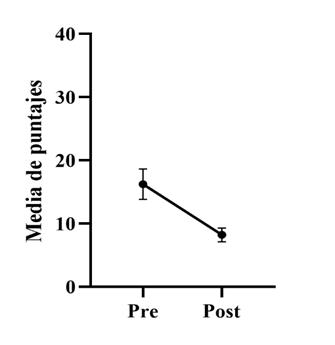
Nota. Se grafica la media de los puntajes totales obtenidos en función del pre y post-tratamiento, presentando en cada fase las barras de error estándar. Se observa una disminución de la media de puntajes en el post-tratamiento.
4.3 Conclusión del estudio 2
En conjunto, los resultados del Estudio 2 muestran cambios consistentes en la dirección esperada tanto a nivel sintomático como cognitivo. Aunque no todas las variables alcanzaron significación estadística, se observaron mejoras relevantes en autoverbalizaciones positivas y una reducción marcada en verbalizaciones negativas, además de aumentos sostenidos en la confianza para hablar en público. A nivel clínico, los puntajes del CORE-OM evidenciaron un cambio significativo en las subescalas de Problemas/Síntomas y Funcionamiento, con índices de cambio confiable superiores al umbral establecido, lo que sugiere mejoras percibidas en áreas centrales del malestar y el funcionamiento cotidiano. En conjunto, estos hallazgos indican que la intervención produjo avances clínicos y cognitivos relevantes, aunque se requiere replicación con muestras mayores para fortalecer la evidencia.
5. Discusión general
El objetivo de esta investigación fue evaluar la viabilidad de una intervención breve basada en terapia de exposición mediante realidad virtual (RV) para reducir el miedo a hablar en público, implementada en modalidad presencial (Estudio 1) y remota (Estudio 2) en estudiantes y egresados universitarios que reportaban ansiedad frente a presentaciones evaluadas.
En conjunto, los resultados aportan evidencia preliminar de que un protocolo breve de terapia de exposición mediante realidad virtual (RV) es implementable en ambos formatos y se asocia a un patrón de cambios cognitivos y funcionales, con mejoras consistentes en autoverbalizaciones y confianza para hablar en público, aun cuando la mayoría de las variables sintomáticas globales no alcanzó significación estadística.
La exposición constituye un componente central de la TCC para los trastornos de ansiedad, porque promueve nuevo aprendizaje en ausencia de la consecuencia temida, favoreciendo la modificación de expectativas de amenaza y la actualización de memorias asociadas al miedo (Craske et al., 2014, 2022). Este proceso requiere activar representaciones temidas y sostener la confrontación con información correctiva, lo que además facilita el cuestionamiento de cogniciones desadaptativas durante o después de la experiencia (Rodenbaugh et al., 2004). En ese sentido, los hallazgos de ambos estudios —particularmente la reducción de autoverbalizaciones negativas (SSPS-N) y el aumento de la confianza para hablar en público (PRCS)— son coherentes con los mecanismos esperables de la exposición: una disminución progresiva de interpretaciones catastróficas y de autoevaluaciones negativas frente al desempeño social, junto con una mayor percepción de autoeficacia ante situaciones de exposición.
Estos resultados también se alinean con la evidencia de que la TCC en formato remoto ha mostrado eficacia para el TAS cuando incluye componentes estructurados, como psicoeducación y exposición (Gadelha et al., 2021; Tan et al., 2025), y con revisiones que describen resultados favorables para la terapia de exposición con RV en ansiedad social y miedo a hablar en público (Chard & van Zalk, 2022; Chesham et al., 2018; Emmelkamp et al., 2020). Recientemente, Espinoza et al. (2025) evaluaron la eficacia de un protocolo de 7–8 sesiones (psicoeducación, flexibilidad cognitiva y 4–5 sesiones de exposición en RV) en un ensayo piloto aleatorizado y controlado, observando mejoras en confianza para hablar en público y reducción de autoverbalizaciones negativas, lo que ofrece un antecedente especialmente relevante por su similitud estructural con el Estudio 2 y por reforzar el vínculo entre el componente de exposición con RV y cambios en variables centrales del miedo a hablar en público.
Los dos estudios del presente trabajo se sitúan dentro del rango de protocolos breves, en línea con intervenciones recientes que han mostrado efectos clínicamente relevantes con tratamientos de 4 a 8 sesiones (Lindner et al., 2021), y comparables también con programas más extensos de 12 a 16 sesiones que suelen integrar psicoeducación, reestructuración cognitiva y exposición graduada (Lindner et al., 2019; Zeka et al., 2024; Zeng et al., 2025). En este contexto, el Estudio 1 (5 sesiones) mostró cambios más focalizados, mientras que el Estudio 2 (6 a 8 sesiones) evidenció un patrón de mejoría más amplio, con incrementos marcados en autoverbalizaciones positivas y mejoras en la confianza para hablar en público hacia el final del proceso. Adicionalmente, se observó un hallazgo funcional relevante no considerado en el diseño original: todos los participantes del Estudio 1 aprobaron su examen de grado, lo que podría sugerir un efecto positivo de la intervención sobre el desempeño evaluativo. Esta interpretación fue coherente con el análisis cualitativo, donde los participantes destacaron la utilidad percibida del tratamiento y señalaron la conveniencia de ampliar el número de sesiones.
La comparación entre estudios sugiere que ciertos ajustes implementados en el Estudio 2 podrían acercarlo más a los diseños multimodales típicos de TCC que incluyen psicoeducación, un componente cognitivo y exposición graduada con monitoreo, lo que coincide con la estructura reportada por Espinoza et al. (2025). En ambos casos, el componente de exposición con RV parece asociarse a cambios en variables especialmente sensibles al miedo a hablar en público (PRCS, SSPS), mientras que medidas más globales del TAS (p. ej., LSAS total) podrían requerir mayor dosis de tratamiento, mayor generalización contextual o mediciones más específicas al subtipo de ansiedad de rendimiento.
Respecto al formato, la modalidad remota resultó factible incluso fuera de la Región Metropolitana, lo que dialoga con la literatura que destaca que las intervenciones digitales pueden ampliar el acceso más allá de los servicios presenciales, sin necesariamente comprometer la calidad de la atención y optimizando costos y continuidad del cuidado (Löchner et al., 2025; Whaibeh et al., 2020). En términos aplicados, esto es particularmente relevante para contextos universitarios donde la demanda suele exceder la oferta de atención psicológica y donde las barreras geográficas y de tiempo pueden limitar el acceso.
Para lograr una interpretación adecuada de la ausencia de diferencias significativas en varias variables, es importante considerar el protocolo como un macroproceso compuesto por componentes con efectos diferenciados: en primer lugar, la dosis y especificidad de la exposición podrían haber sido determinantes, dado que la exposición con RV busca activar el miedo anticipatorio y generar aprendizaje correctivo, pero su impacto depende del número de ensayos, la intensidad, la variabilidad de escenarios y la progresión jerárquica, lo que podría explicar que en el Estudio 1 la brevedad del protocolo —reportada cualitativamente como obstaculizador— limitara cambios en medidas más globales, mientras que en el Estudio 2 el uso de jerarquías y la posibilidad de ajustar sesiones habría aumentado la “dosis efectiva” de exposición. En segundo lugar, la incorporación de un componente cognitivo y de flexibilidad en el Estudio 2 (respiración y flexibilidad cognitiva) pudo facilitar la disposición a exponerse, la tolerancia al malestar y la reevaluación posterior, contribuyendo al aumento en autoverbalizaciones positivas y a la mejora en confianza hacia el final del proceso. En tercer lugar, la calidad de la inmersión también podría haber influido, ya que en el Estudio 1 el uso de un software en inglés con traducción simultánea probablemente redujo la espontaneidad y el nivel de activación emocional requerido para maximizar el aprendizaje, mientras que el cambio a una plataforma en español en el Estudio 2 habría disminuido esta fricción y favorecido exposiciones más verosímiles; finalmente, la dinámica temporal del cambio y la sensibilidad de las medidas permiten comprender por qué los efectos fueron más consistentes en indicadores directamente vinculados al desempeño público (autoverbalizaciones y confianza), típicamente más sensibles a intervenciones breves, mientras que escalas más amplias como el LSAS total podrían no captar adecuadamente cambios en un subtipo específico o requerir intervenciones de mayor alcance, y los incrementos no significativos en ansiedad estado o rasgo podrían reflejar activación situacional asociada al proceso de exposición, a la cercanía de evaluaciones reales o al momento del postest, sin implicar necesariamente un deterioro clínico.
En conjunto, los resultados respaldan la viabilidad y potencial utilidad clínica de una intervención breve con exposición en RV para miedo a hablar en público en población universitaria, con especial promesa en formatos remotos por su escalabilidad. Esto adquiere relevancia en Chile y Latinoamérica, donde la investigación y aplicación de RV en intervenciones para trastornos de ansiedad sigue siendo limitada (Santoyo et al., 2021). En este marco, intervenciones breves, estructuradas y apoyadas por tecnología pueden contribuir a ampliar cobertura, reducir barreras de acceso y apoyar el funcionamiento académico, aspecto particularmente relevante en estudiantes universitarios (González & Quezada, 2016) y consistente con objetivos de salud mental poblacional y promoción de bienestar (MINSAL, 2017, 2022).
Finalmente, los resultados de ambos estudios aportan evidencia útil para la formulación de políticas públicas en salud mental universitaria. En un país con alta prevalencia de ansiedad y brechas de acceso, intervenciones breves, costo-efectivas y apoyadas por tecnologías emergentes representan una oportunidad significativa para mejorar el bienestar emocional y el rendimiento académico de los estudiantes.
5.1 Recomendaciones para la acción
Los hallazgos permiten priorizar elementos que parecen más vinculados a los cambios observados: (a) psicoeducación grupal para normalización y adherencia; (b) construcción de jerarquías y exposición gradual; (c) video-feedback y revisión de creencias asociadas al desempeño; (d) módulo cognitivo breve (flexibilidad cognitiva) y estrategias de regulación (respiración/mindfulness) para sostener la exposición; y (e) plataformas en español que reduzcan fricción y favorezcan inmersión. Para favorecer la implementación remota, resulta clave estandarizar orientación técnica y medidas de seguridad, junto con estrategias de adherencia (recordatorios, tareas breves asincrónicas y materiales simples) y, tecnologías de bajo costo (p. ej., visores de cartón y plataformas en español).
Respecto a la implementación, los profesionales a cargo deben contar con competencias en tecnologías aplicadas a la práctica clínica, manejo de técnicas de exposición, acompañamiento grupal y enfoques inclusivos que permitan atender la diversidad del estudiantado. Para su escalamiento institucional, es necesario articular la intervención con centros de apoyo psicológico, direcciones de bienestar estudiantil y unidades de innovación educativa, lo que facilita infraestructura, monitoreo clínico y sostenibilidad. La intervención puede adaptarse fácilmente a distintos subgrupos; en el caso de estudiantes con discapacidad, se recomienda una entrevista previa para ajustar recursos (subtítulos, audios descriptivos o reducción de estímulos sensoriales).
Esta intervención también puede complementar estrategias ya existentes en salud mental universitaria, como talleres de habilidades socioemocionales o programas de acompañamiento académico. Finalmente, los hallazgos respaldan la pertinencia de promover políticas públicas que integren tecnologías accesibles en la atención psicológica estudiantil, dada su eficiencia, bajo costo y potencial para ampliar la cobertura, especialmente en instituciones con alta demanda o estudiantes en regiones alejadas.
5.2 Limitaciones y direcciones futuras
Las limitaciones metodológicas —diseño sin grupo control en ambos estudios, muestras pequeñas y no probabilísticas, y ausencia de seguimiento— restringen inferencias causales y generalización. En futuras investigaciones se recomienda avanzar hacia diseños controlados y comparativos (p. ej., exposición en RV versus exposición en vivo o imaginería; intervención breve versus estándar), incorporar seguimientos y medir con mayor precisión variables específicas del subtipo de ansiedad de rendimiento. Dado que en la literatura existen ensayos piloto controlados con protocolos estructuralmente similares (Espinoza et al., 2025), una dirección relevante es utilizar estos antecedentes para definir medidas primarias sensibles (PRCS, SSPS) y criterios de respuesta clínica, además de evaluar moderadores (p. ej., severidad inicial, comorbilidad, cercanía de evaluaciones académicas, adherencia a tareas).
Asimismo, conviene estandarizar indicadores de “dosis” de exposición (número de ensayos, nivel de activación, progresión en jerarquías), ya que la ausencia de cambios significativos en algunas medidas podría deberse a una exposición insuficiente o a variaciones en la intensidad/realismo de los escenarios.
6. Conclusiones
Este estudio permitió examinar la viabilidad de un protocolo breve de exposición mediante realidad virtual orientado específicamente al miedo a hablar en público, en modalidades presencial y remota, en población universitaria. En relación con los objetivos propuestos, los hallazgos indican que la intervención es implementable en ambos formatos y que se asocia a cambios relevantes en indicadores directamente vinculados al desempeño en situaciones de habla en público, particularmente en procesos cognitivos y de autoevaluación (autoverbalizaciones y confianza para hablar en público), sin observar efectos adversos relevantes.
Desde una perspectiva aplicada, los resultados sugieren que este tipo de intervención puede constituir una herramienta complementaria y de apoyo para programas de salud mental universitaria, especialmente en contextos donde la demanda supera la capacidad de atención presencial. El formato remoto, en particular, presenta ventajas operativas que lo hacen pertinente para instituciones de educación superior, al facilitar la cobertura territorial, la flexibilidad horaria y la optimización de recursos, manteniendo una estructura coherente con intervenciones basadas en evidencia.
En términos de implicancias para tomadores de decisiones y diseñadores de políticas públicas, los hallazgos respaldan la pertinencia de incorporar tecnologías inmersivas dentro de estrategias de atención psicológica breve y focalizada, especialmente en contextos educativos. Intervenciones de este tipo pueden contribuir a reducir barreras de acceso, apoyar el funcionamiento académico y fortalecer dispositivos preventivos y de intervención temprana en salud mental estudiantil, en consonancia con los lineamientos actuales de promoción y cuidado de la salud mental.
Finalmente, el estudio aporta evidencia empírica desde un contexto latinoamericano respecto al uso de realidad virtual en el abordaje del miedo a hablar en público, un subtipo altamente prevalente y funcionalmente relevante de la ansiedad social. Con ello, contribuye al desarrollo de intervenciones innovadoras, escalables y culturalmente pertinentes, y establece una base para futuras investigaciones orientadas a consolidar su eficacia y optimizar su integración en sistemas de atención psicológica y políticas de salud mental.
References
American Psychiatric Association. (2022). Diagnostic and statistical manual of mental disorders (5th ed., text rev.). American Psychiatric Publishing.
Baker, S., Heinrichs, N., Kim, H., & Hofmann, S. (2002). The Liebowitz Social Anxiety Scale as a self-report instrument: a preliminary psychometric analysis. Behaviour Research and Therapy, 40(6), 701–715. https://doi.org/10.1016/S0005-7967(01)00060-2
Barlow, D. H., Farchione, T. J., Sauer-Zavala, S., Latin, H. M., Ellard, K. K., Bullis, J. R., Bentley, K. H., Boettcher, H. T., Casiello-Robbins, C. (2019). Protocolo unificado para el tratamiento transdiagnóstico de los trastornos emocionales. Manual del Terapeuta. Alianza Editorial.
Bobes, J., Badía, X., Luque, A., García, M., González, M., & Dal-Re, R. (1999). Validación de las versiones en español de los cuestionarios Liebowitz Social Anxiety Scale. Social Anxiety and Distres Scale y Sheehan Disability Inventory para la evaluación de la fobia social. Medicina Clínica, 112, 14-16. https://www.unioviedo.es/psiquiatria/wpcontent/uploads/2017/03/1999_Bobes_Validaci on_MedClinicaBCN.pdf
Centro UC. (2024). Novena Ronda del Termómetro de la Salud Mental Achs-UC: Salud mental mejora en Chile pero aún hay más de un millón de personas con síntomas que dice no necesitar tratamiento. https://encuestas.uc.cl/?p=2358
Chard I., & van Zalk N. (2022). Virtual Reality Exposure Therapy for Treating Social Anxiety: A Scoping Review of Treatment Designs and Adaptation to Stuttering. Frontiers in Digital Health, 4. https://doi.org/10.3389/fdgth.2022.842460
Chesham, R., Malouff, J., & Schutte, N. (2018). Meta-Analysis of the Efficacy of Virtual Reality Exposure Therapy for Social Anxiety. Behaviour Change, 35(3), pp.152- 166. https://doi.org/10.1017/bec.2018.15
Chowdhury, N., & Khandoker, A. H. (2023). The gold-standard treatment for social anxiety disorder: A roadmap for the future. Frontiers in Psychology, 13, 1070975. https://doi.org/10.3389/fpsyg.2022.1070975
Craske, M.G., Treanor, M., Conway, C.C., Zbozinek, T., & Vervliet, B. (2014). Maximizing exposure therapy: an inhibitory learning approach. Behaviour Research and Therapy, 58, 10–23. https://doi.org/10.1016/j.brat.2014.04.006
Craske, M. G., Treanor, M., Zbozinek, T. D., & Vervliet, B. (2022). Optimizing exposure therapy with an inhibitory retrieval approach and the OptEx Nexus. Behaviour Research and Therapy, 152, 104069. https://doi.org/10.1016/j.brat.2022.104069
de la Rubia, J., Antona, C., & García, C. (2012). Validación del inventario de ansiedad y fobia social en una muestra de estudiantes universitarios mexicanos. Salud & Sociedad, 3(3), 313–331. https://doi.org/10.22199/S07187475.2012.0003.00006
Derogatis, L. R. (1975). The SCL-90-R. Clinical psychometric research.
Dwivedi, A. K., Mallawaarachchi, I., & Alvarado, L. A. (2017). Analysis of small sample size studies using nonparametric bootstrap test with pooled resampling method. Statistics in Medicine, 36(14), 2187-2205. https://doi.org/10.1002/sim.7263
Echeverría, G. (2005). Análisis cualitativo por categorías. Universidad Academia de Humanismo Cristiano. Escuela de Psicología. Santiago.
Elliott, R., & Rodgers, B. (2008). Client Change Interview Schedule (v5). University of Strathclyde, Glasgow.
Emmelkamp P. M. G., Meyerbröker K., & Morina N. (2020). Virtual Reality Therapy in Social Anxiety Disorder. Current Psychiatry Reports, 22(32). https://doi.org/10.1007/s11920-020-01156-1
Espinoza, S. A., Salazar, C. C., Valdés, G. A., Silva, M. F., Varas, F. I., Ayala, G., Munro, G., Laborda, M. A., Miguez, G., & Quezada-Scholz, V. E. (2025). Efficacy of a Virtual Reality Exposure Therapy Protocol for Fear of Public Speaking: A Randomized Controlled Pilot Study. Behavioral Psychology, 33(3), 49436. https://doi.org/10.31083/BP49436
Estrada, E., Ferrer, E., & Pardo, A. (2019). Statistics for evaluating pre-post change: Relation between change in the distribution center and change in the individual scores. Frontiers in Psychology, 9, 1–12. https://doi.org/10.3389/fpsyg.2018.02696
Feixas, G., Evans, C., Trujillo, A., Saúl, L., Botella, L., Corbella, S., González, E., Bados, A., García-Grau, E., & López-González, M. (2012). La versión española del CORE-OM: Clinical Outcomes in Routine Evaluation - Outcome Measure. Revista de Psicoterapia, 23(89), 109–135. https://doi.org/10.33898/rdp.v23i89.641
Ferrer, R., & Pardo, A. (2014). Clinically meaningful change: False positives in the estimation of individual change. Psychological Assessment, 26(2), 370–383. https://doi.org/10.1037/a0035419
Gadelha, M. J., Silva, L. R., Oliveira, A. P., Cavalcante, N. A., Araújo, V. S., Lopes, R. T., & Silva, N. G. (2021). Internet Cognitive Behavioral Therapy for social anxiety disorder: a systematic review. Revista Brasileira de Terapias Cognitivas, 17(2), 96-104. https://doi.org/10.5935/1808-5687.20210022
Girondini, M., Stefanova, M., Pillan, M., & Gallace, A. (2023). Speaking in front of cartoon avatars: A behavioral and psychophysiological study on how audience design impacts on public speaking anxiety in virtual environments. International Journal of Human-Computer Studies, 179. https://doi.org/10.1016/j.ijhcs.2023.103106
González, G. & Quezada V. E. (2016). A brief cognitive-behavioral intervention for stress, anxiety and depressive symptoms in dental students. Research in Psychotherapy: Psychopathology, Process and Outcome, 19, 68-78. https://doi.org/10.4081/ripppo.2016.192
Hall, M., Luo, A., Bhullar, N., Moses, K., & Wootton, B. M. (2024). Cognitive behaviour therapy for social anxiety disorder: A systematic review and meta-analysis investigating different treatment formats. Australian Psychologist, 59(1), 1–12. https://doi.org/10.1080/00050067.2024.2356804
Hofmann, S. G., & DiBartolo, P. M. (2000). An instrument to assess self-statements during public speaking: Scale development and preliminary psychometric properties. Behavior Therapy, 31(3), 499–515. https://doi.org/10.1016/s0005-7894(00)80027-1
Hook, J. N., Smith, C. A., & Valentiner, D. P. (2008). Personal Report of Confidence as a Speaker--Short Form (PRCS-12) [Database record]. APA PsycTests. https://doi.org/10.1037/t20159-000
Ibacache-Ramírez, S., Quezada-Scholz, V., Laborda-Rojas, M., San Martín, M. C., Alfaro, F., & Miguez-Cavieres, G., (2025). Estudio psicométrico del Inventario de Ansiedad Estado-Rasgo en adultos de Santiago. Terapia Psicológica, 43(3), 303-322.
Kaczkurkin, A. N., & Foa, E. B. (2015). Cognitive-behavioral therapy for anxiety disorders: an update on the empirical evidence. Dialogues in clinical neuroscience, 17(3), 337-346. https://doi.org/10.31887/DCNS.2015.17.3/akaczkurkin
Keller, F., & Alexandrowicz, R. W. (2024). Assessing Individual Change: A Comparison of Reliable Change Indices Based on Classical Test Theory and Various Item Response Theory Models. In: Stemmler, M., Wiedermann, W., Huang, F.L. (Eds.) Dependent Data in Social Sciences Research. Springer, Cham. https://doi.org/10.1007/978-3-031-56318-8_28
Kindred, R., Bates, G. W., & McBride, N. L. (2022). Long-term outcomes of cognitive behavioural therapy for social anxiety disorder: A meta-analysis of randomised controlled trials. Journal of Anxiety Disorders, 92, 102640. https://doi.org/10.1016/j.janxdis.2022.102640
Liebowitz, M. R. (1987). Social phobia. Modern Problems of Pharmacopsychiatry, 22, 141–173. https://doi.org/10.1159/000414022
Lindner, P., Dagöö, J., Hamilton, W., Miloff, A., Andersson, G., Schill, A., & Carlbring, P. (2021). Virtual Reality exposure therapy for public speaking anxiety in routine care: A single-subject effectiveness trial. Cognitive Behaviour Therapy, 50(1), 67–87. https://doi.org/10.1080/16506073.2020.1795240
Lindner, P., Miloff, A., Fagernäs, S., Andersen, J., Sigeman, M., Andersson, G., Furmark, T., & Carlbring, P. (2019). Therapist-led and self-led one-session virtual reality exposure therapy for public speaking anxiety with consumer hardware and software: A randomized controlled trial. Journal of Anxiety Disorders, 61, 45-54. https://doi.org/10.1016/j.janxdis.2018.07.003
Löchner, J., Carlbring, P., Schuller, B., Torous, J., & Bosse Sander, L. (2025). Digital interventions in mental health: An overview and future perspectives. Internet Interventions, 40. https://doi.org/10.1016/j.invent.2025.100824
Martinez-Pecino, R., & Durán, M. (2013). Social communication fears: factor analysis and gender invariance of the short-form of the personal report of confidence as a speaker in Spain. Personality and Individual Differences, 55(6), 680–684. https://doi.org/10.1016/j.paid.2013.05.017
Méndez, F. X., Inglés, C. J., & Hidalgo, M. D. (2004). La versión española abreviada del “cuestionario de confianza para hablar en público” (Personal Report of Confidence as Speaker): Fiabilidad y validez en población adolescente. Psicología Conductual: Revista Internacional de Psicología Clínica de la Salud, 12(1), 25–42.
Ministerio de Salud. (2017). Plan Nacional de Salud Mental 2017-2025. Gobierno de Chile. https://www.minsal.cl/wp-content/uploads/2017/12/Plan-Nacional-Salud-Mental-2017-2025.pdf
Ministerio de Salud. (2022). Estrategia Nacional de Salud para el cumplimiento de los Objetivos Sanitarios de la Década 2021-2030. Gobierno de Chile. https://www.minsal.cl/wp-content/uploads/2022/07/Estrategia-Nacional-de-Salud-2021-2030.pdf
Ncube, M. (2024). npboottprm (Version 0.3.2) [R package]. Comprehensive R Archive Network. https://doi.org/10.32614/CRAN.package.npboottprm
Pedram, S., & Piatkowski, T. (2025). Exploring the potential of virtual reality (VR) in mental healthcare: a systematic literature review. Virtual Reality, 29, 135 (2025). https://doi.org/10.1007/s10055-025-01181-6
Quezada-Scholz, V. E., Laborda, M. A., San Martín, C., Miguez, G., Alfaro, F., Mallea, J., & Díaz, F. (2022). Cued fear conditioning in humans using immersive Virtual Reality. Learning and Motivation, 78. https://doi.org/10.1016/j.lmot.2022.101803
Rodebaugh, T. L., Holaway, R. M., & Heimberg, R. G. (2004). The treatment of social anxiety disorder. Clinical psychology review, 24(7), 883-908. https://doi.org/10.1016/j.cpr.2004.07.007
Santoyo, A., Ayala, A., Laborda, M., Miguez, G., San Martin, C., Alfaro, F., Diaz, F., & Quezada-Scholz, V. E. (2021). Uso de realidad virtual en la investigación e intervención en miedo y ansiedad: una revisión sistemática breve [Undergraduate Thesis, Universidad de Chile]. Repositorio Académico de la Universidad de Chile. https://repositorio.uchile.cl/handle/2250/195048
Tan, Y. L., Chang, V. Y. X., Ang, W. H. D., Ang, W. W., & Lau, Y. (2025). Virtual reality exposure therapy for social anxiety disorders: a meta-analysis and meta-regression of randomized controlled trials. Anxiety, Stress & Coping, 38(2), 141–160. https://doi.org/10.1080/10615806.2024.2392195
Trujillo, A., Feixas, G., Bados, A., García-Grau, E., Salla, M., Medina, J. C., Montesano, A., Soriano, J., Medeiros-Ferreira, L., Cañete, J., Corbella, S., Grau, A., Lana, F., & Evans, C. (2016). Psychometric properties of the Spanish version of the Clinical Outcomes in Routine Evaluation – Outcome Measure. Neuropsychiatric Disease and Treatment, 16, 1457-1466. https://doi.org/10.2147/NDT.S103079
Whaibeh, E., Mahmoud, H., & Naal, H. (2020). Telemental health in the context of a pandemic: The COVID-19 experience. Current Treatment Options in Psychiatry, 7(2), 198–202. https://doi.org/10.1007/s40501-020-00210-2
Wolpe, J. (1969). Subjective Units of Distress Scale (SUDS) [Database record]. APA PsycTests. https://doi.org/10.1037/t05183-000
World Health Organization (2023). 2023 Emerging technologies and scientific innovations: A global public health perspective. World Health Organization. https://iris.who.int/bitstream/handle/10665/370365/9789240073876-eng.pdf?sequence=1
Wright, D. B., London, K., & Field, A. P. (2011). Using bootstrap estimation and the plug-in principle for clinical psychology data. Journal of Experimental Psychopathology, 2(2), 252-270. https://doi.org/10.5127/jep.013611
Zeka, F., Clemmensen, L., Valmaggia, L., Veling, W., Hjorthøj, C., & Glenthøj, L. B. (2024). The effectiveness of immersive virtual reality‐based treatment for mental disorders: A systematic review with meta‐analysis. Acta Psychiatrica Scandinavica, 151(3), 210–230. https://doi.org/10.1111/acps.13777
Zeng, W., Xu, J., Yu, J., & Chu, X. (2025). Effectiveness of virtual reality therapy in the treatment of anxiety disorders in adolescents and adults: A systematic review and meta-analysis of randomized controlled trials. Frontiers in Psychiatry, 16, 1553290. https://doi.org/10.3389/fpsyt.2025.1553290
Statements
Author Contributions: The study was conceptualized by GPAA, VEQS, MAL, GM, MCSM; data collection was carried out by GPAA, JEFV, SIR, LPG; while data analyses were conducted by GPAA, VEQS, LPG and MFS; the initial manuscript draft was prepared by GPAA, MFS, GAV, CCS and SAE; VEQS participated in and supervised all stages of the research, providing intellectual leadership and overseeing the scientific and formative aspects of the work. All authors have read and agreed to the published version of the manuscript.
Funding: This study was funded by Fondecyt de Iniciación, #11170143, titled "Relación entre la vulnerabilidad para el desarrollo de los trastornos de ansiedad y el aprendizaje del miedo", principal researcher: Vanetza E. Quezada-Scholz.
Acknowledgments: We would like to thank Monica Ruffat, Director of the Psychology Unit at the Faculty of Law, Universidad de Chile, for her valuable administrative support in the management of this project. We also thank Geraldine Walters for facilitating access to the Amelia platform and for her ongoing commitment to promoting scientific research.
Conflicts of Interest: The authors declare no conflict of interest.
Ethics Committee Review Statement: The study was conducted in accordance with the Declaration of Helsinki and approved by the Ethics Committee of Universidad de Chile, Approval letter number 19-06-2021.
Informed Consent Statement: Informed consent was obtained from all subjects involved in the study.
Data Availability Statement: The data is available on direct request to the corresponding author by e-mail.
Artificial Intelligence Statement: During the preparation of this manuscript, the authors did not use artificial intelligence tools.